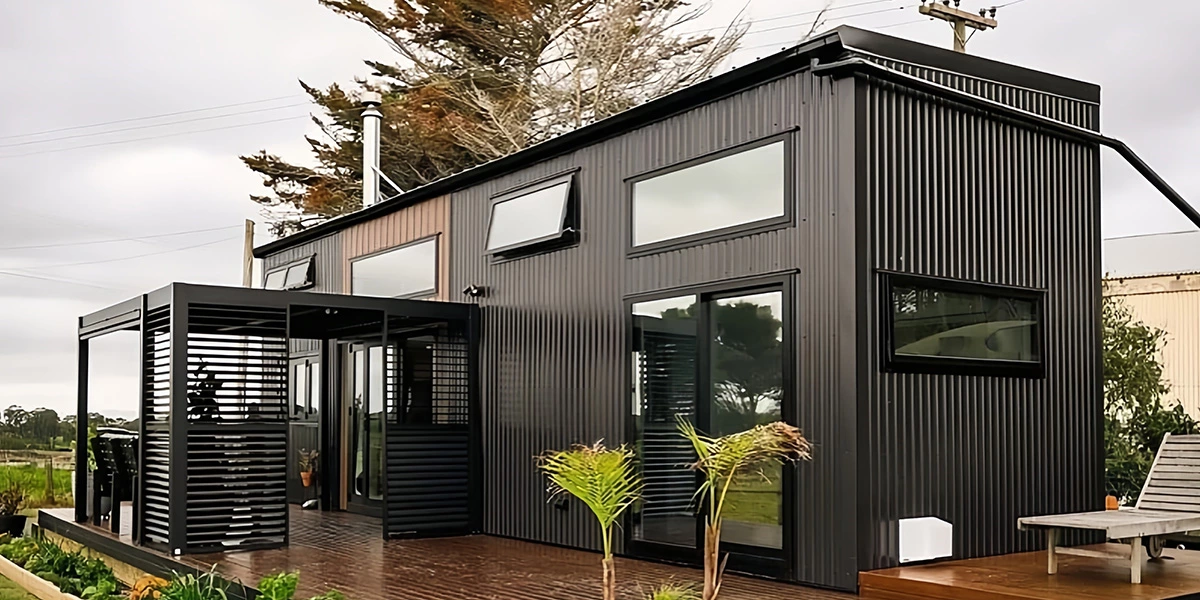
20ft Expandable Container House: Specs, Price & Complete Buyer's Guide
The 20ft expandable container house has become one of the most searched prefab housing solutions globally — and for good reason. It ships as a compact standard container, deploys to nearly three times its transport width in under an hour, and delivers a fully liveable 38㎡ home at a fraction of traditional construction costs. But with hundreds of factories now producing this format, knowing exactly what separates a quality unit from a cheap import can save you tens of thousands of dollars.
What Is a 20ft Expandable Container House?
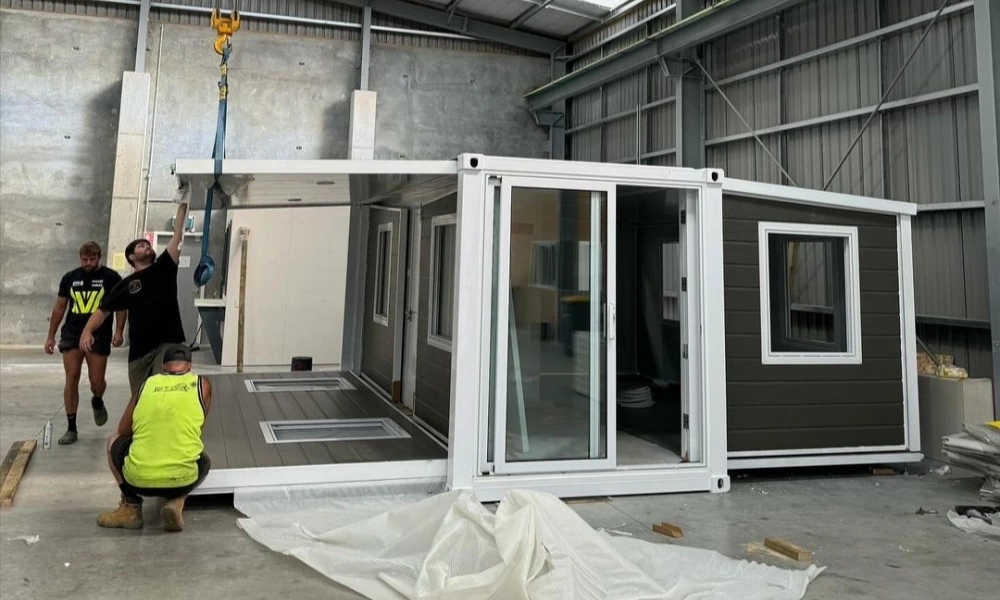
A 20ft expandable container house is a factory-built modular dwelling that folds flat for shipping and expands on-site into a full-sized living space. Unlike static shipping container conversions, the expandable design uses a hinged or sliding three-section frame — a fixed central core flanked by two foldable side wings — that deploys without cranes, specialist tools, or on-site construction crews.
Core dimensions at a glance:
| State | Length | Width | Height | Floor Area |
|---|---|---|---|---|
| Folded (transport) | 5,900mm | 2,200mm | 2,480mm | ~13㎡ |
| Expanded (living) | 5,900mm | 6,454mm | 2,480mm | ~38㎡ |
The 38㎡ expanded footprint comfortably accommodates a studio, 1-bedroom, or 2-bedroom layout depending on interior partition configuration — making it one of the most space-efficient prefab solutions available at this price point.
20ft Expandable Container House Price: What to Expect in 2026
Price is the first question every buyer asks — and the one most suppliers avoid answering directly. Here is an honest 2026 price breakdown:
Ex-Factory (EXW/FOB) Price
| Configuration | Ex-Factory Price Range | What's Included |
| Basic shell (structural only) | $5,300–$8,000 | Frame, panels, windows, doors |
| Standard fit-out | $8,000–$12,000 | Shell + bathroom + kitchenette + flooring |
| Premium full fit-out | $12,000–$18,000 | Full spec including appliances, solar-ready |
All-In Landed Cost (USA / Australia / Europe)
| Destination | Ocean Freight | Import Duty | Foundation | Utilities | Total All-In |
| USA | $3,500–$5,000 | 0–5% | $3,000–$8,000 | $3,000–$12,000 | $28,000–$50,000 |
| Australia | $2,500–$4,500 | 0–5% | $3,000–$8,000 | $3,000–$10,000 | $25,000–$45,000 |
| Europe | $2,200–$3,800 | 3.7% (EU) | $3,000–$8,000 | $2,500–$8,000 | $26,000–$48,000 |
Full Technical Specifications
Structural Frame System
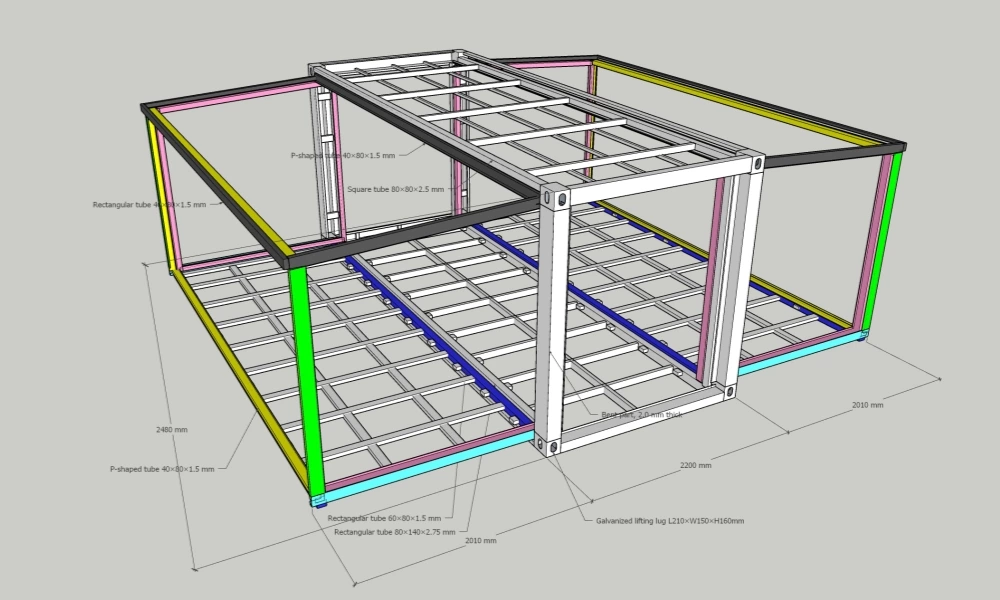
The structural integrity of any 20ft expandable container house is determined entirely by its frame specification. Here is what UVO's Australian and internationally-certified unit uses:
| Component | UVO Specification | Why It Matters |
| Frame steel grade | G550 galvanised (AS/NZS 1397) | 2.3× stronger than standard Q235 grade |
| Main columns | 150×210mm heavy-duty section | Withstands hoisting and transport loads |
| Floor main beams | 80×40 / 60×80 rectangular tube | Prevents ground deformation and subsidence |
| Side extension columns | 40×80×1.5mm / 80×80×2.5mm square tube | Provides lateral stability under wind load |
| Galvanisation layer | ≥180g/㎡ (≥275g/㎡ coastal spec) | Corrosion resistance 30+ years |
| Connectors | 316 stainless steel (ASTM A276) | ≥1,000 hours salt spray resistance |
| Wind resistance | Wind Force 11–12 (130–150 mph) | Suitable for cyclone-rated areas |
| Seismic rating | Magnitude 8 equivalent | Engineered for high-seismic zones |
| Structural finish | Hot-dip galvanised + electrostatic powder coat | Dual corrosion protection layer |
Wall and Insulation System
| Component | Standard Spec | Upgrade Option |
| Wall panel type | 75mm EPS colour steel sandwich panel | 100mm PU or PIR fire-rated panel |
| Thermal conductivity | ≤0.039 W/m·K (EPS) | ≤0.024 W/m·K (PU) |
| Fire rating | B2 (EPS standard) | A1/B1 (PIR or Rock Wool upgrade) |
| Exterior cladding | PVDF-coated aluminium-magnesium-manganese alloy | Timber-effect or stone-effect composite |
| Interior wall finish | Painted steel or bamboo fibre board | Formaldehyde-free bamboo (≤0.05mg/m³) |
Floor System
| Component | Standard Spec | Upgrade |
| Subbase layer 1 | 18mm cement fibre board | MGO board (higher fire rating) |
| Subbase layer 2 | 18mm plywood | - |
| Floor finish | 2.0mm PVC wear-resistant | SPC waterproof flooring |
| Termite resistance | Cement fibre board is termite-proof | - |
| Moisture resistance | Both layers are moisture-resistant | - |
Door and Window System
| Component | Specification |
| Windows | Double-glazed tempered glass, thermal break aluminium alloy frame |
| Sliding performance | 60% improvement in thermal insulation vs standard single-pane |
| Main entrance door | Insulated steel security door (standard) or large glass sliding door (option) |
| Sound insulation | Excellent — suitable for urban and near-road installations |
Floor Plan Options for the 20ft Expandable Container House
At 38㎡ expanded, the 20ft expandable house floor plan can be configured in three standard layouts:
Layout A — Open-Plan Studio (Best for Airbnb / Solo Living)
- Bedroom zone: ~14㎡ (queen bed + wardrobe)
- Living + kitchen area: ~18㎡
- Bathroom: ~5㎡
- Storage: ~1㎡
Layout B — 1 Bedroom + Separate Living (Most Popular)
- Bedroom: ~12㎡
- Living + dining: ~14㎡
- Kitchen: ~6㎡
- Bathroom: ~5㎡
Layout C — 2 Bedroom Compact (Best for Granny Flat / Staff)
- Bedroom 1: ~10㎡
- Bedroom 2: ~8㎡
- Shared kitchen + living: ~12㎡
- Bathroom: ~5㎡
Custom partition configurations are available — specify your preferred layout at order stage and UVO produces to your floor plan.
Pros and Cons of a 20ft Expandable Container House
No buyer's guide is complete without an honest assessment. Here is what owners and resort operators report after 12–24 months of use:
Pros
Speed: The most cited advantage. A 20ft expandable container house for sale in Australia or the USA can be ordered, shipped, and installed in 8–14 weeks — vs 6–18 months for any comparable site-built structure.
Cost: At $25,000–$50,000 all-in landed in most markets, it costs 60–70% less than a comparable site-built structure. For granny flat, Airbnb, and resort applications, payback periods of 18–30 months are typical.
Portability: The unit retains its ability to be relocated — crane it back onto a truck, refold, and redeploy to a new site. No other permanent dwelling type offers this.
Structural durability: G550 steel frame with hot-dip galvanisation is engineered for 30+ years in most environments, including coastal and alpine conditions.
Self-contained: Everything arrives pre-integrated — no coordinating multiple trades for framing, plumbing, electrical, and cladding.
Cons
Ceiling height: At 2,480mm (8.1ft), the interior height is adequate but lower than Australian standard new-build (2,400mm is the NCC minimum, which this meets exactly). Buyers used to 2,700mm+ ceilings in new homes may find it slightly compact.
Floor area limitation: 38㎡ is comfortable for 1–2 people but tight for a family of 3+. If you need 55㎡+, a 30ft or 40ft model is the appropriate choice.
Foundation requirement: Despite the name "expandable", the unit requires a proper foundation (screw pile or concrete slab) for permanent or long-term use. "Just drop it on the ground" is not a compliant installation in Australia, the US, or Europe.
Not all imports are equal: The market is flooded with low-grade 20ft expandable container houses for sale using Q235 steel, uncertified electrical systems, and sub-standard insulation. These units look identical in photos but fail council approval, deteriorate faster, and carry real safety risks.
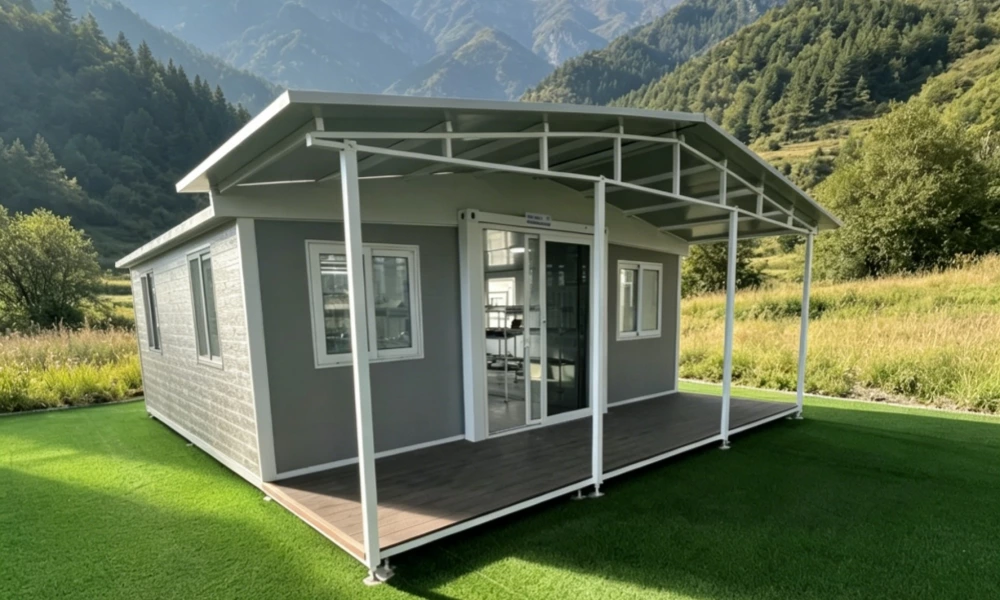
Who Is the 20ft Expandable Container House Best Suited For?
| Use | Is 20ft Suitable? | Recommended Configuration |
| Solo professional / couple permanent home | Excellent | 1BR layout + full kitchen |
| Granny flat / secondary dwelling | Excellent | 1–2BR, compliant spec |
| Airbnb / short-term rental | Excellent | Studio or 1BR, premium fit-out |
| Glamping pod (single unit) | Excellent | Studio, panoramic door option |
| Family of 3–4 primary home | Borderline | 2BR but tight — consider 30ft |
| Large family (4+) | Not suitable | Upgrade to 40ft |
| Staff dormitory (1–4 people) | Excellent | 2–3BR compact layout |
| Remote off-grid retreat | Excellent | Solar-ready config + tank |
Shipping and Installation Guide
How Many Units Fit in a Shipping Container?
The 20ft expandable container house folds to transport dimensions of 5,900mm × 2,200mm × 2,480mm. Two units load into one standard 40HQ shipping container — significantly reducing per-unit freight cost for buyers ordering 2+ units.
What Foundation Does a 20ft Expandable House Need?
- Screw pile (helical pier): Recommended for sloped sites, remote locations, and fast installations. 4–6 piles required. Install time: half a day.
- Concrete slab: Most widely accepted by Australian and US councils for permanent use. Install time: 3–7 days including cure.
- Perimeter footings: Required by some European authorities for permanent structures.
How Long Does On-Site Installation Take?
- Site preparation (foundation): 0.5–7 days depending on type
- Unit delivery and crane placement: 2–4 hours
- Unfolding and securing: 1–2 hours
- Utility connections (by licensed trades): 1–3 days
- Total from crane arrival to liveable: typically 2–5 days
Certifications Available for the 20ft Expandable Container House
- Australia:SAA (AS/NZS 3000), WaterMark (AS/NZS 3500), NATA asbestos-free, NCC compliance statement
- USA:IBC structural engineering certificate, UL-compatible electrical
- Europe:CE (EU CPR 305/2011), RoHS, ISO 9001
Frequently Asked Questions
What is the price of a 20ft expandable container house in 2026?
Ex-factory prices range from $5,300 (basic shell, no certification) to $18,000+ (full residential fit-out with compliance documentation). UVO's fully certified 20ft expandable container house for sale starts from $15,000 ex-factory — the price difference versus cheap imports reflects G550 structural grade, SAA/WaterMark/CE certification, and the council approval documentation package.
Can a 20ft expandable house be used as a permanent home in Australia?
Yes — when installed on an approved foundation, connected to utilities, and granted council approval (DA or CDC), the UVO 20ft expandable container house meets NCC Class 1a requirements for permanent habitable use. The SAA, WaterMark, and NATA certifications are mandatory for this approval pathway and are included with every UVO unit.
How does the 20ft expandable house compare to the 40ft model?
The 20ft offers 38㎡ at lower cost and fits two units in one 40HQ shipping container. The 40ft offers 72–80㎡ — nearly double the space — at higher unit price but with greater floor area versatility (up to 3 full bedrooms with separate living). For Airbnb, glamping, and granny flat use, the 20ft delivers the fastest ROI; for family living and permanent primary homes, the 40ft is the more practical choice.
Does the 20ft expandable house include a bathroom and kitchen?
UVO's standard configuration includes a pre-fitted bathroom (toilet, shower, basin) and kitchenette (sink, benchtop, under-counter space). Full appliance packages are available as upgrades. The electrical and plumbing systems are pre-integrated at the factory — only final utility connections by licensed local tradespeople are required on-site.
How do I avoid buying a low-quality 20ft expandable container house?
Ask for four documents before committing: (1) structural engineering certificate confirming steel grade and load ratings, (2) electrical certification (SAA for Australia, UL-compatible for USA, CE for Europe), (3) plumbing certification (WaterMark for Australia), and (4) NATA asbestos-free report for Australian buyers. If a supplier cannot provide all four, the unit is not council-approvable in regulated markets.