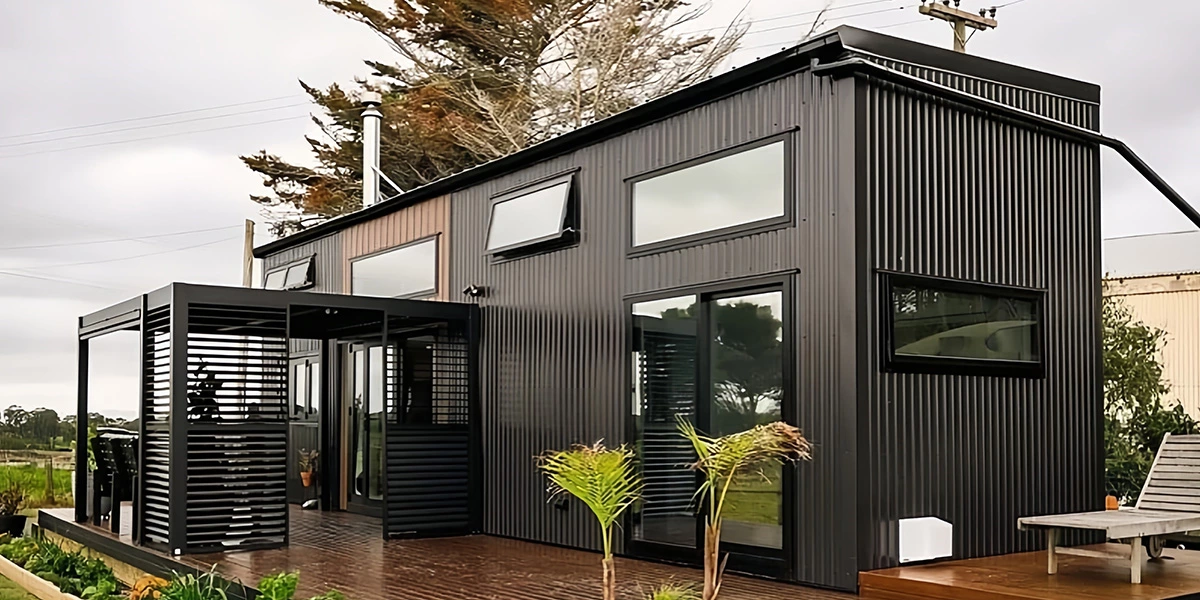
How Expandable Container House Get Class 1A Council Approval in Australia?
One of the most common questions Australian buyers ask before purchasing an expandable container house is whether it can actually get council approval as a permanent dwelling. The short answer is yes — but only if it meets NCC Class 1A classification requirements. View our fully NCC compliant expandable container house
What Is a Class 1A Building in Australia?
Under Australia's National Construction Code (NCC) — also known as the Building Code of Australia (BCA) — every habitable structure is assigned a building classification that determines the standards it must meet.
Class 1A is the classification assigned to:
- A single residential dwelling (house, cottage, cabin)
- A granny flat or secondary dwelling used for long-term residential purposes
- A detached studio used as a permanent habitable space
A Class 1A expandable container house is treated identically to a conventionally-built house under Australian law. It must meet the same performance requirements — structural integrity, energy efficiency, fire safety, electrical compliance, plumbing compliance, and minimum habitability standards — regardless of how it was manufactured or where it came from.
This is the critical distinction most buyers miss. Purchasing an expandable container house without Class 1A documentation does not make it non-compliant — it makes it legally uninhabitable in Australia until it receives council approval, and council approval requires Class 1A compliance evidence.

Why Most Imported Expandable Container Houses Fail Class 1A
The Australian expandable container house market is flooded with products manufactured to Chinese domestic standards, European CE standards, or no recognised standard at all. These units may look identical to a compliant product in photographs — but they cannot pass council scrutiny because they lack the documentation that proves NCC compliance.
The most common Class 1A failure points for imported expandable houses:
| Compliance Area | NCC Class 1A Requirement | Typical Import Failure |
|---|---|---|
| Structural engineering | Certificate from Australian-registered engineer | Generic Chinese or CE structural documents — not accepted by Australian councils |
| Energy efficiency | 7-star NatHERS rating (mandatory from NCC 2022) | Standard EPS panels insufficient for most climate zones |
| Electrical | SAA certification (AS/NZS 3000) | Chinese or European wiring standards — non-compliant with Australian grid |
| Plumbing | WaterMark certification (AS/NZS 3500) | Uncertified fixtures — fail Australian plumbing inspections |
| Fire safety | Minimum fire hazard properties for wall linings | EPS insulation often fails Australian fire rating |
| Asbestos-free | NATA-accredited laboratory test report | No testing — automatic council rejection |
| Ceiling height | Minimum 2.4m in habitable rooms | Many imported units at 2.3m or lower |
Without documentation addressing every one of these points, an expandable container house council approval application in Australia will be rejected — often after the buyer has already paid for the unit and freight.
What Class 1A Approval Actually Means for Your Expandable Container House
Achieving Class 1A council approval for your expandable container house unlocks everything that makes the investment worthwhile:
Legal habitation: You can legally live in the structure as a permanent or long-term residence. Without Class 1A approval, permanent occupation is not lawful.
Utility connections: You can formally connect to mains water, sewerage, and electricity through licensed trades. Informal connections without approval are code violations and void insurance.
Granny flat approval: In all Australian states, secondary dwellings (granny flats) must be Class 1A certified. An unapproved structure cannot function as a lawful granny flat, regardless of its physical quality.
Insurance coverage: Home and contents insurance on a habitable structure requires council approval. Unapproved structures are typically excluded from coverage — a catastrophic risk on a $40,000+ asset.
Property value impact: A council-approved Class 1A expandable container house adds measurable value to your property. An unapproved structure adds legal liability.
Resale protection: When you sell the property, an approved secondary dwelling is an asset. An unapproved one is a liability requiring mandatory disclosure and often forced removal.
The Class 1A Approval Process: Step by Step
Getting Class 1A council approval for an expandable container house in Australia follows the same pathway as any permanent dwelling — because that is exactly what it is under the NCC.
Step 1: Preliminary Site Assessment
Before ordering your expandable container house, engage a building certifier or town planner for a preliminary site assessment. Provide your site plan, lot dimensions, and proposed unit placement. This assessment identifies:
- Zoning classification and permitted uses
- Setback requirements from boundaries
- Overlay restrictions (bushfire, flood, heritage, ecological)
- Which approval pathway applies: DA or CDC
This step costs $300–$1,500 and is the most cost-effective investment you can make before committing to a purchase.
Step 2: Confirm Your Approval Pathway
Based on your state and site conditions:
| State | Class 1A Pathway | Typical Timeline |
|---|---|---|
| NSW | CDC (Complying Development Certificate) via private certifier — for lots 450m²+ under 60m² with no overlays | 10–20 business days |
| QLD | Accepted Development — building permit only for secondary dwellings under 80m² in residential zones | 2–4 weeks |
| VIC | Building permit (registered building surveyor) — no planning permit required in GRZ for Small Second Dwellings under 60m² | 4–6 weeks |
| WA | Exempt from planning approval for ancillary dwellings up to 70m² on 450m²+ lots — certification only | 1–3 weeks |
| SA | Code Assessed via PlanSA portal | Up to 40 business days |
| ACT | Development Application (DA) | 6–12 weeks |
Step 3: Confirm Documentation Package from Your Supplier
This is where most Class 1A applications stall. Your council or certifier requires a complete documentation package — and if your supplier cannot provide it, you will need to commission expensive third-party engineering reports or, in many cases, abandon the approval process entirely.
What UVO provides with every Australian-standard expandable container house:
- Structural engineering certificate — issued by a registered engineer, confirming the unit meets AS 1170, AS 4100, and AS 4600 requirements for wind, snow, and seismic loads at your specific installation location
- NCC Class 1A compliance statement — confirming the unit meets all NCC Section H performance requirements for habitable dwellings
- SAA electrical certification (AS/NZS 3000) — Australian standard wiring rules compliance
- WaterMark plumbing certification (AS/NZS 3500) — all plumbing components certified for Australian mains connection
- NATA asbestos-free test report — from a NATA-accredited laboratory, confirming all materials are asbestos-free
- Energy performance specification data — supporting NatHERS assessment for your climate zone
- Scaled floor plans and elevation drawings — DA/CDC-ready format, A3 and A1 available
- Site plan template — showing standard setback positions for preliminary certifier assessment
Step 4: Lodge Your Application
Submit through your state's portal with the complete UVO documentation package. In most cases, UVO's documentation is accepted directly — no additional third-party engineering reports required.
Step 5: On-Site Professional Connections
Once approval is granted, licensed Australian trades complete the final connections:
- Licensed plumber: Water supply, drainage, hot water system connection (WaterMark-certified fixtures throughout)
- Licensed electrician: Mains power connection and SAA certification of the installed system
- Building certifier: Oversees the installation process and issues the final Occupancy Certificate (OC)
The Occupancy Certificate is your legal confirmation that the expandable container house has been inspected, approved, and is lawful to occupy as a Class 1A dwelling.
UVO Australian-Standard Expandable Container House: Built for Class 1A from Day One
Most expandable container house manufacturers build to a generic export standard and then attempt to retrofit Australian compliance documentation. UVO's Australian-standard range takes the opposite approach — every technical specification is determined by NCC Class 1A requirements from the initial engineering design.
Structural: G550 Steel for Australian Wind and Seismic Zones
| Component | UVO Australian Standard | NCC / AS Requirement |
|---|---|---|
| Frame steel grade | G550 galvanised (AS/NZS 1397) — 550 MPa yield strength | Meets AS 4600 cold-formed steel |
| Galvanisation | ≥180g/㎡ standard; ≥275g/㎡ coastal specification | AS 4680 hot-dip galvanising |
| Structural connectors | 316 stainless steel (ASTM A276) — 1,000hr salt spray tested | AS 3566 corrosion resistance |
| Wind resistance | Level 11–12 (130–150 mph) — engineering certified per county | AS 1170.2 wind actions |
| Seismic | Grade 8 equivalent | AS 1170.4 seismic actions |
7-Star NatHERS Compliance by Climate Zone
From NCC 2022 (implemented 2024), all new Class 1A dwellings in Australia must achieve a 7-star NatHERS energy efficiency rating. UVO provides insulation specifications for every Australian climate zone:
| Climate Zone | Location Examples | Recommended UVO Insulation | NatHERS Outcome |
|---|---|---|---|
| Zone 1 (Hot humid) | Darwin, Cairns | 75mm PU panels + Low-E glazing | 7-star |
| Zone 2 (Warm humid) | Brisbane, Gold Coast | 75mm PU panels + Low-E glazing | 7-star |
| Zone 4 (Mixed) | Sydney, Perth | 75mm PU or Rock Wool + Low-E | 7-star |
| Zone 6 (Cold) | Melbourne, Canberra | 100mm Rock Wool + Low-E | 7-star |
| Zone 7 (Very cold) | ACT alpine, NE Victoria | 100mm Rock Wool + triple glaze option | 7-star |
Electrical: SAA-Certified for Australian Grid Connection
Every UVO Australian-standard expandable container house is factory-wired to AS/NZS 3000 (Australian Wiring Rules):
- Australian standard Type I 3-pin sockets throughout
- SAA-certified circuit breakers and distribution board
- RCBO protection (combines RCD + circuit breaker) for all circuits
- Smoke alarm wiring per NCC Specification 3 requirements
- Separate circuits for general power, lighting, kitchen, and bathroom
Plumbing: WaterMark-Certified for Mains Connection
All plumbing components in UVO's Australian-standard units carry WaterMark certification under AS/NZS 3500:
- WaterMark-certified tapware, toilet suite, shower fixtures, and drainage
- Pre-plumbed cold and hot water connections ready for licensed plumber connection
- Wet area waterproofing to AS 3740 — factory-completed and tested

Class 1A Expandable Container House at a Glance
| State | Max Size (Granny Flat) | Key Class 1A Documents | Fast-Track Pathway |
|---|---|---|---|
| NSW | 60m² | NCC statement, SAA, WaterMark, NATA, BASIX, structural engineering | CDC — 10–20 business days |
| QLD | 80m² | NCC statement, SAA, WaterMark, NATA, structural engineering | Accepted Development — building permit only |
| VIC | 60m² | NCC statement, SAA, WaterMark, 7-star NatHERS, structural engineering | Building permit only (GRZ, no overlays) |
| WA | 70m² | NCC statement, SAA, WaterMark, R-Codes compliance, structural engineering | Planning exemption — certification only |
| SA | 60m² | NCC statement, SAA, WaterMark, NATA, rainwater tank compliance | Code Assessed via PlanSA — 40 business days |
| ACT | 80m² | NCC statement, SAA, WaterMark, NATA, structural engineering | DA — 6–12 weeks |
Frequently Asked Questions
Can an expandable container house get Class 1A council approval in Australia?
Yes — when it is manufactured to NCC Class 1A standards and supplied with the required documentation (structural engineering certificate, SAA electrical, WaterMark plumbing, NATA asbestos-free report, NCC compliance statement). UVO's Australian-standard expandable container houses are designed specifically for this approval pathway. Council approval has been achieved in NSW, QLD, VIC, WA, SA, and ACT.
What is the difference between Class 1A and Class 10 for an expandable container house?
Class 1A is the NCC classification for a permanent habitable dwelling — the same standard applied to a conventional house. Class 10 covers non-habitable structures such as sheds, garages, carports, and outbuildings. An expandable container house used as a granny flat, guest house, or primary residence must be Class 1A. Class 10 structures cannot be legally slept in or used as permanent accommodation.
Does a 7-star NatHERS rating apply to expandable container houses?
Yes — from NCC 2022, all new Class 1A dwellings in Australia must achieve 7-star NatHERS. This applies to expandable container houses in exactly the same way as any other new residential building. UVO provides insulation specifications and energy performance data to support NatHERS assessments across all Australian climate zones.
How long does Class 1A council approval take for an expandable container house?
Approval timelines vary by state and pathway: NSW CDC takes 10–20 business days; QLD building permit takes 2–4 weeks; VIC building permit takes 4–6 weeks; WA exempt pathway requires only certification (1–3 weeks); SA PlanSA takes up to 40 business days; ACT DA takes 6–12 weeks.
Do I need a licensed builder to install a Class 1A expandable container house in Australia?
Yes — installation must be completed by a licensed builder or approved owner-builder in most Australian states. On-site utility connections (water, sewer, electricity) must be completed by licensed plumbers and electricians. The final occupancy certificate is issued by your building certifier after inspection.
Does UVO provide all the documents needed for Class 1A approval?
Yes. Every UVO Australian-standard expandable container house includes: structural engineering certificate, NCC Class 1A compliance statement, SAA electrical certification, WaterMark plumbing certification, NATA asbestos-free test report, energy performance specification data, and scaled floor plans and elevation drawings in DA/CDC-ready format.