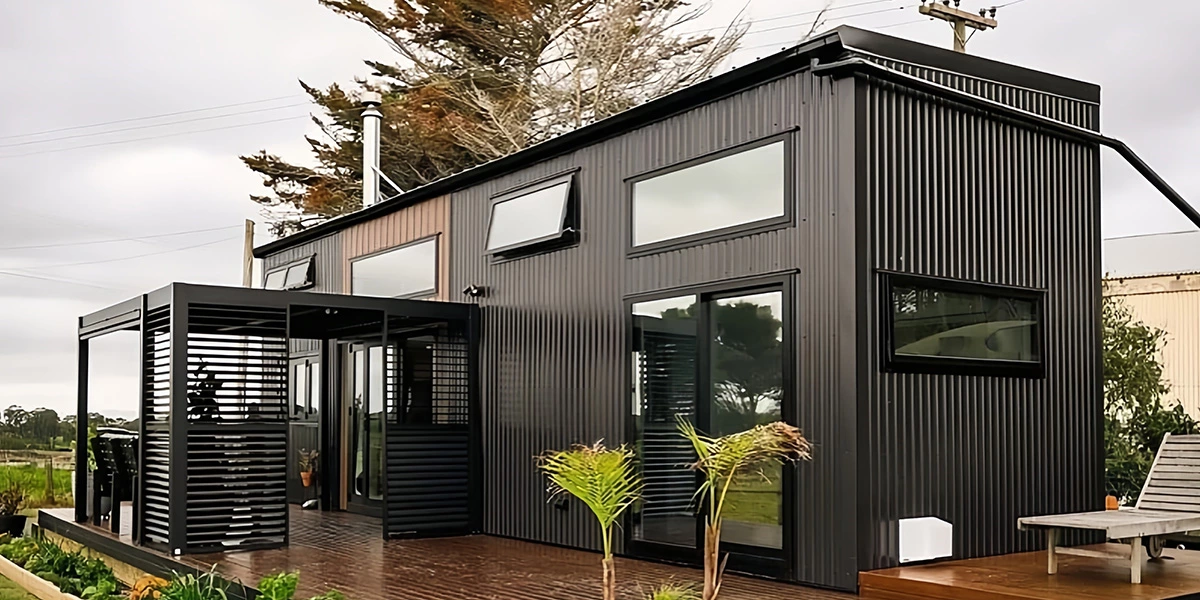
Expandable Container House ADU: Backyard Setup Guide, Permits & ROI
The average cost to build a traditional backyard ADU in the US has climbed to180,000 and incities like LosAngeles or San Francisco, that number can hit 300,000 or more. That's why thousands of American homeowners are turning to a faster, more affordable alternative: the expandable container house. If you've been searching for an expandable container house for sale in the USA that can legally function as a backyard ADU, this guide covers everything you need to know — from zoning rules and permit steps to cost, ROI, and the best models available.
What Is an ADU — and Why Does an Expandable Container House Qualify?
An Accessory Dwelling Unit (ADU) is a secondary residential unit on the same lot as a primary home. When permanently placed on an approved foundation and connected to utilities, an expandable container house ADU is classified and permitted identically to any other site-built ADU.
What makes an expandable container house for sale USA buyers are increasingly choosing as their ADU solution is a combination of four advantages no traditional ADU construction method can match simultaneously:
1. Speed
Traditional backyard ADU construction takes 8–18 months from permit to move-in. A factory-built expandable container house ADU arrives 80–90% complete and installs in 1–3 days on-site — with a total timeline of 3–5 months from order to occupancy.
2. Cost
Traditional detached ADU construction runs $150–$400 per square foot across most US markets. The all-in landed and installed cost of a prefab ADU expandable unit from UVO — including shipping to most US states, foundation, and utility hookup — typically lands between $45,000–$90,000. That represents a 55–70% cost saving versus traditional construction.
3. Compliance Documentation
Unlike basic shipping container conversions, UVO's expandable container house ADU units are engineered to IBC residential standards with 2.4m interior ceiling heights, compliant electrical (UL/NEC), and full structural engineering documentation — everything your local building department requires.
4. Rental Income Potential
The US backyard ADU container home rental market is producing $1,500–$5,000+ per month in major metros. At $2,000/month net, a $65,000 all-in expandable container house for sale installation reaches full payback in under 3 years.
US ADU Market 2026: Why This Is the Best Time to Install a Backyard ADU
The US ADU market has hit an inflection point:
- California issued over 24,000 ADU permits in 2024 — a state record — and expanded the ministerial approval mandate (60-day decision, no discretionary review)
- Texas cities including Austin and Houston have dramatically simplified ADU permitting since 2023, with no owner-occupancy requirements
- Florida county-by-county ADU ordinances have been updated across Miami-Dade, Hillsborough, and Orange County to allow detached ADUs up to 1,000 sq ft
- National: ADUs now represent the fastest-growing segment of US housing supply, and 34 states have passed ADU-friendly legislation since 2020
For homeowners who want an expandable container house for sale USA delivery and installation in their backyard, 2026 is the most permissive regulatory environment in US history.

Why an Expandable Container House Is Ideal for ADU Use
1. Speed of Installation
A traditional site-built ADU takes 6–18 months from permit to move-in. An expandable container house arrives largely pre-built from the factory. Once your permits are approved and your foundation is ready, the unit can be craned into position and made livable in days, not months.
2. Cost Advantage
Traditional detached ADU construction costs 150–150–400 per square foot. A factory-built expandable container house — including shipping to most US states — typically lands in the 25,000–25,000–75,000 range depending on size and specifications. The savings are significant, even after adding permit fees, foundation, and utility hookup costs.
3. Built to Residential Code
Modern expandable container houses from manufacturers like UVO are engineered to meet IBC (International Building Code) residential standards, with 2.4m (approximately 8-foot) interior ceiling heights, insulated wall panels, compliant electrical and plumbing systems, and structural engineering certificates. This is what separates them from basic storage containers — they are designed to be lived in.
4. Factory Precision, Minimal Site Disruption
Because the unit arrives 80–90% complete, there's minimal on-site construction activity. No concrete crews working for weeks, no lumber deliveries blocking your driveway. For suburban properties where neighbor relations and HOA sensitivities matter, this is a practical advantage.
Different states' ADU rules for expandable container houses
California — Best State for Expandable Container House ADU
Key rules:
- Maximum ADU size: 1,200 sq ft (detached)
- Minimum lot size: No statewide minimum
- Setbacks: 4-foot rear and side minimum (state standard)
- Permit timeline: Ministerial approval within 60 days — no discretionary review
- Owner-occupancy: Removed statewide through 2030
For expandable container house ADU use in California: A 20ft UVO expandable unit (~37m², approximately 400 sq ft) fits comfortably within California's limits on most residential lots. The unit qualifies as a detached ADU when placed on a compliant foundation.
California-specific requirement — HERS energy compliance: California requires a Home Energy Rating System certificate. UVO's insulated panel system meets the performance criteria — confirm with your certifier that your specific unit specification satisfies your climate zone.
Texas — Most Permissive State for Expandable Container House ADU
Texas has no statewide prohibition on expandable container house ADU use. Regulations are entirely local (city/county).
Key markets:
- Austin: ADUs permitted by-right on most residential lots (minimum 5,750 sq ft). Maximum 1,100 sq ft or 15% of lot area. No owner-occupancy requirement.
- Houston: No traditional zoning ordinance — backyard ADU container home installations are generally permissible with a building permit. One of the most ADU-friendly cities nationally.
- Dallas: ADUs allowed in most residential zones with building permit.
- Rural Texas (unincorporated counties): Minimal or no building codes — a prefab ADU expandable installation can often proceed with minimal bureaucracy outside city limits.
Texas ADU grant: Texas does not currently offer a statewide ADU subsidy, but several cities (Austin) have forgivable loan programs for eligible homeowners.
Florida — Growing ADU Market for Expandable Container Homes
Florida's county-level ADU rules have been significantly updated 2024–2026.
Key counties:
- Miami-Dade: Detached ADUs permitted in eligible zones. Must meet Florida Building Code (FBC).
- Hillsborough County (Tampa): ADUs up to 1,000 sq ft — 2024 ordinance update.
- Orange County (Orlando): ADUs allowed with building permit.
Florida-specific requirement — wind load: Florida mandates wind-load compliance for all structures. UVO's expandable container house ADU units are rated Wind Load 11–12 (130–150 mph), meeting Florida's hurricane standards in most zones. Confirm your specific county's wind speed requirement with your engineer.
Coastal counties: Additional FEMA flood zone requirements may mandate elevated foundations — confirm before site preparation.
How to Get Your Expandable Container House ADU Permitted: Step-by-Step
Step 1: Check Your Zoning
Before searching for an expandable container house for sale USA options, verify your lot's zoning. Visit your county/city GIS or planning portal and confirm:
- Is an ADU (detached secondary dwelling) allowed in your zone?
- What is the maximum ADU size?
- What are the setback requirements (distance from property lines)?
- Are there height restrictions?
- Does your property have an HOA? (CC&Rs may restrict backyard ADU container home installations even where municipally permitted)
Step 2: Confirm Utility Connections
Your expandable container house ADU requires:
- Electricity: New sub-panel or meter from main house service
- Water: Extension of existing supply line or new meter
- Sewer/Septic: Connection to city sewer or septic capacity evaluation
Confirm with your local utility provider what is required. In some jurisdictions, adding an ADU may require a sewer capacity evaluation.
Step 3: Choose Your UVO Expandable House Model
The most common UVO models for ADU use:
| Model | Expanded Size | Bedrooms | ADU Use |
| 20ft Expandable | 400 sq ft | Studio / 1BR | Single professional, young couple, home office + sleeping |
| 30ft Expandable | 600 sq ft | 1–2BR | Small family, rental unit, senior in-law suite |
| 40ft Expandable | 800 sq ft | 2-4BR / 1-2BA | Full family ADU, premium rental, long-term tenant |
Step 4: Assemble Your Expandable Container House ADU Permit Package
A standard US ADU building permit application requires:
- Site plan (setbacks, existing structures, placement)
- Floor plan and elevations (UVO provides these)
- Structural engineering report (UVO provides IBC-compliant certificate)
- Energy compliance documentation (HERS or equivalent)
- Plumbing and electrical plans
- Foundation design by licensed engineer
UVO provides the complete documentation package: engineering certificates, floor plans, elevations, compliance statements — everything your expandable container house ADU permit application needs.
Step 5: Assemble Your Permit Package
A typical ADU permit application requires:
- Site plan (showing placement, setbacks, existing structures)
- Floor plan and elevations (UVO provides these)
- Structural engineering report (UVO provides)
- Energy compliance documentation (HERS or equivalent)
- Plumbing and electrical plans
- Foundation design by a licensed engineer
UVO provides a complete documentation package — engineering certificates, floor plans, elevations, and compliance statements — to support your permit submission.
Step 6: Submit and Wait
Submit to your local building department. Timeline varies:
- California: 60 days (state mandate for ministerial ADU permits)
- Texas: 4–12 weeks (varies by city)
- Florida: 4–12 weeks (varies by county)
- Other states: 6–16 weeks typically
Step 7: Foundation and Site Prep
While your permit is processing, prepare the site:
- Clear vegetation and grade the area
- Install utilities rough-in (trenching for water/sewer/electric)
- Pour foundation or install screw piles
Step 8: Delivery and Installation
UVO ships directly to US ports. Typical timeline from order to US delivery: 8–12 weeks. Once on-site, the expandable unit is craned into position, unfolded, and secured to the foundation in a single day.
Step 9: Final Connections and Inspection
Licensed electricians and plumbers complete utility connections. Schedule your final building inspection. Once approved, you receive your Certificate of Occupancy (CO) — the unit is now legally habitable.

What Can Your Backyard ADU Actually Earn?
Based on 2025–2026 US rental data:
| Location | Monthly Rental Income (ADU) | Annual Income | Payback Period |
| Los Angeles, CA | 1,800–3,500 | 21,600–42,000 | 1.5–4 years |
| Austin, TX | 1,400–2,200 | 16,800–26,400 | 2–5 years |
| Miami, FL | 1,500–2,800 | 18,000–33,600 | 2–5 years |
| Seattle, WA | 1,600–2,800 | 19,200–33,600 | 2–4 years |
| Phoenix, AZ | 1,200–1,900 | 14,400–22,800 | 3–6 years |
| Nashville, TN | 1,200–1,800 | 14,400–21,600 | 3–6 years |
Beyond rental income, an ADU typically adds 20–30% to your property's market value — making your expandable container house ADU a double-return investment.
Common ADU Uses for an Expandable Container House
Long-term rental income: The most common use. Consistent monthly income with a tenant. Strongest ROI over time for most US markets.
Short-term rental (Airbnb / VRBO): In high-demand markets like Nashville, Scottsdale, and coastal Florida, a well-designed backyard ADU container home generates $3,000–$6,000/month. Verify local STR registration requirements before listing.
Multi-generational living: House an aging parent, adult child, or in-law with separate entrance and private kitchen and bathroom — preserving both households' privacy.
Home office / studio: A dedicated workspace separate from the main house for remote workers, creative professionals, or therapists needing a client-facing space.
Guest house: Host visitors without surrendering space in the main home.
Frequently Asked Questions
Is an expandable container house considered a permanent structure for ADU purposes?
Yes — when placed on a permitted foundation (concrete slab or helical piers) and connected to utilities, an expandable container house is classified and permitted as a permanent dwelling, the same as any site-built ADU.
Can I put an expandable container house ADU in my backyard without a permit?
No. In every US state, a habitable structure used as a residence requires a building permit. Unpermitted ADUs face forced removal, fines, and can create serious title issues when you sell the property.
How big can my ADU be?
This depends on your local zoning rules. Most US jurisdictions cap detached ADUs at 600–1,200 sq ft. UVO's 20ft and 30ft models comfortably fit within these limits. The 40ft model (approximately 800 sq ft expanded) also fits in most markets.
Does UVO ship expandable container houses to all US states?
Yes. UVO ships to all contiguous US states via major ports including Los Angeles, Houston, Miami, New York, and Seattle. Typical transit time from factory to US port is 25–35 days.
What certifications do UVO expandable houses have for US use?
UVO's expandable houses carry CE structural certification, IBC-compliant engineering, and full documentation packages including structural calculations, floor plans, and elevation drawings for permit submissions.
Can I get financing for an expandable container house ADU?
Yes. Options include personal loans, home equity loans (HELOC), ADU-specific construction loans, and Buy Now Pay Later platforms. Contact UVO for current financing partner recommendations for the US market.
Ready to Add an Expandable Container House ADU to Your Property?
With housing demand at record levels and ADU regulations becoming more permissive across the US every year, there has never been a better time to add a backyard ADU — and an expandable container house offers the fastest, most cost-effective way to do it.
UVO's expandable container houses for sale in the USA are engineered to IBC residential standards, backed by full documentation for permit applications, and available in 20ft, 30ft, and 40ft configurations to fit your lot and budget.