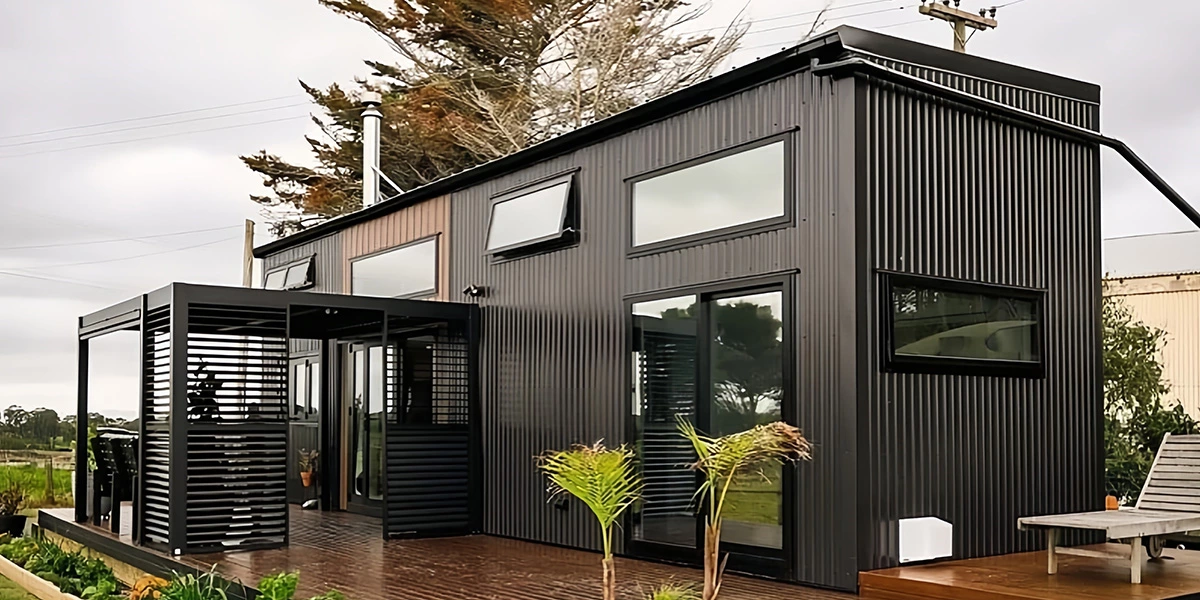
Expandable House vs Traditional Home: 10-Year Cost Comparison
Thinking about buying or building a home and wondering whether an expandable container house is actually cheaper in the long run? The upfront price difference is obvious. What's less obvious is what happens to that gap over 10 years once you factor in construction time, maintenance, utilities, financing, and resale value.
Why a 10-Year View Matters
Most expandable house vs traditional home cost discussions stop at the purchase price. That's misleading in both directions.
An expandable container house looks dramatically cheaper upfront — and it often is. But a traditional home may appreciate faster in some markets, and financing terms differ. On the other hand, traditional homes carry higher maintenance costs, longer construction timelines, and significantly higher labour costs — all of which compound over a decade.
The only way to make a fair comparison is to look at the Total Cost of Ownership (TCO) over 10 years: what you pay in, what you get back, and what you actually live with.
We'll break it down across six categories:
- Upfront purchase and construction cost
- Construction timeline (time = money)
- Financing and interest
- Annual maintenance and repairs
- Utilities and running costs
- Resale and property value impact

Upfront Purchase and Construction Cost
Traditional Home
According to 2026 US construction data, the average cost to build a new home in the United States is $150–$300 per square foot, with the national median sitting around $166 per square foot for standard builds. For a modest 1,500 sq ft home:
- Entry-level: $130–$160 per square foot; cost for 1,500 square feet is $195,000–$240,000.
- Mid-range: $160–$250 per square foot; cost for 1,500 square feet is $240,000–$375,000.
- High-end: $250–$500+ per square foot; cost for 1,500 square feet is $375,000–$750,000+.
This figure excludes land, which in most US metro areas adds another $50,000–$500,000+ depending on location. It also excludes architect fees (typically $5,000–$30,000), permit fees ($5,000–$25,000), and landscaping.
In Australia, the picture is similar. Building a new home costs approximately AUD $1,800–$4,500 per square metre in 2026, putting a modest 100m² home at AUD $180,000–$450,000 before land.
When buyers research container home vs traditional build USA Australia, this is usually where the conversation starts — but it's only one piece of the picture.
Expandable Container House
A factory-built expandable container house has a fundamentally different cost structure. The unit is manufactured off-site and delivered largely complete — reducing labour, material waste, and on-site construction time significantly.
Typical all-in project cost (unit + foundation + utilities + delivery, excludes land):
| Model | Expanded Size | US | AU |
| 20ft expandable | ~400 sq ft / ~37m² | $45,000–$85,000 | AUD $55,000–$100,000 |
| 30ft expandable | ~600 sq ft / ~55m² | $60,000–$110,000 | AUD $75,000–$130,000 |
| 40ft expandable | ~800 sq ft / ~75m² | $80,000–$140,000 | AUD $95,000–$160,000 |
Even when accounting for site works, foundation, and utility connections, an expandable container house costs a fraction of a comparable traditionally-built structure. For buyers on tight budgets, this difference is the entire conversation.
Construction Timeline
Traditional Home
- Design and planning: 1–3 months
- Permits: 1–6 months (varies by location)
- Construction: 7–14 months (average for standard builds)
- Total: 12–24 months from decision to move-in
Expandable Container House
- Design selection and order: 1–2 weeks
- Factory production: 4–6 weeks
- Shipping to US/Australia: 3–5 weeks
- Permits and site prep (parallel): 4–12 weeks
- Installation: 1–3 days
- Total: 3–5 months from order to move-in
Time saving: 9–18 months faster
If you're currently paying $2,000/month in rent while waiting for a traditional build, that's $18,000–$36,000 in rent saved by the faster expandable house timeline alone — a hidden cost that rarely appears in prefab vs traditional construction cost.
Financing and Interest Cost
Traditional Home Mortgage
A $300,000 construction loan or mortgage at 7% over 30 years (current US average rates in 2026) generates:
- Monthly payment: ~$1,996
- Total interest paid over 30 years: ~$418,000
- Total repaid: ~$718,000
Over just 10 years, the interest component on a $300,000 loan at 7% is approximately $200,000 — more than the entire purchase price of many expandable houses.
Expandable Container House Financing
With a lower upfront cost, buyers have several advantages:
- Smaller loan amount: A $80,000 expandable house project financed at 7% over 10 years carries roughly $30,000 in interest — vs $200,000 for the traditional home scenario
- Personal loan option: Many expandable house purchases can be financed with a personal loan (no mortgage required), simplifying the process
- Cash purchase possible: At $45,000–$85,000 all-in, cash purchases — eliminating interest entirely — are realistic for many buyers
10-year financing cost saving: $50,000–$170,000 (depending on loan amounts and terms)
Annual Maintenance and Repairs
This is where traditional homeowners are consistently surprised — and where the expandable house vs traditional home cost advantage over time becomes most clear.
Traditional Home Maintenance Costs
Industry data from Pearl Certification's 2026 Annual Report shows that US home maintenance costs have risen 42% in five years, averaging $8,808 per year in 2025 for a typical American home. The standard rule of thumb — set aside 1–4% of home value annually for maintenance:
- With a home value of $200,000 and an annual maintenance budget of $2,000–$8,000, the cost over 10 years would amount to $20,000–$80,000.
- With a home value of $500,000 and an annual maintenance budget of $5,000–$20,000, the cost over 10 years would amount to $50,000–$200,000.
Major traditional home maintenance items over 10 years typically include:
- Roof: Repair or partial replacement — $3,000–$15,000
- HVAC system: Service + replacement — $5,000–$15,000
- Plumbing: Pipes, hot water system, fixtures — $2,000–$10,000
- Painting (interior + exterior): $5,000–$20,000
- Foundation issues: If they occur — $5,000–$50,000+
- Windows and doors: $2,000–$10,000
- Landscaping and drainage: $3,000–$15,000
Expandable Container House Maintenance Costs
The steel frame and factory-assembled construction of an expandable container house eliminates many of the cost categories above:
- No timber framing = no rot, termite damage, or warping
- Integrated insulated panels = no cavity wall moisture issues
- Steel cladding = no periodic repainting of cladding (powder coat lasts 15–20 years)
- Factory-fitted windows and seals = minimal weatherproofing maintenance
Typical annual maintenance for a quality expandable container house:
- Anti-corrosion inspection and touch-up: $200–$500/year
- HVAC service: $200–$500/year
- General interior maintenance: $300–$800/year
- Total: approximately $700–$1,800/year
10-year maintenance cost comparison:
The annual maintenance cost for a traditional home ranges from $3,500 to $14,000, totaling $35,000 to $140,000 over 10 years; for an expandable home, the annual cost is $700 to $1,800, totaling $7,000 to $18,000 over 10 years, resulting in savings of $28,000 to $122,000 over the decade.
Utilities and Running Costs
Energy Efficiency
Modern expandable container houses built to current NCC or IBC residential standards use insulated sandwich panel systems — typically 75–100mm thick polyurethane or rock wool core panels — that deliver strong thermal performance in both hot and cold climates.
When designed to meet the current mandatory 7-star NatHERS (Australia) or IECC energy code (USA) requirements, an expandable container house performs comparably to — or better than — a standard timber-framed home of the same era.
Key energy factors:
- Insulated panels: R-values typically equivalent to well-insulated stud-wall construction
- Thermal mass: Lower than brick/concrete — requires more active heating/cooling in extreme climates
- Compact footprint: Smaller volume means less energy to heat and cool
- Airtightness: Factory assembly typically produces tighter building envelopes than site-built construction
Estimated annual utility cost comparison (800 sq ft / 75m² unit):
| Climate | Traditional Home (1,500 sq ft) | Expandable House (800 sq ft) |
| Temperate (e.g. Brisbane, Portland) | $1,800–$2,800/year | $900–$1,500/year |
| Hot (e.g. Phoenix, Darwin) | $2,500–$4,000/year | $1,200–$2,200/year |
| Cold (e.g. Minnesota, Victoria alpine) | $3,000–$5,000/year | $1,500–$2,800/year |
Note: Part of the expandable house utility advantage comes from smaller floor area. For a true apples-to-apples container home vs traditional build USA Australia utility comparison at the same floor area, the gap narrows — but the compact expandable house still wins on total running cost for most practical use cases.
10-year utility saving: $9,000–$25,000 (vs comparable traditional home of same era)
Resale Value and Property Impact
This is the most nuanced category — and where honest acknowledgment matters.
Traditional Home
Traditional homes in established neighbourhoods have a long track record of appreciation. In the US, the median home price has historically appreciated 3–4% annually. In Australia, major city markets have delivered 5–8% annually over the long term.
A $350,000 home appreciating at 4%/year is worth approximately $518,000 after 10 years — a gain of $168,000.
Expandable Container House
The resale picture for expandable container houses is evolving rapidly as the category matures. Key factors:
Land value still appreciates: If the expandable house is on land you own, the land appreciates regardless of the structure on it. In many scenarios — particularly rural land, ADU use, or investment properties — the land component drives most long-term value growth.
Unit depreciation: Unlike a traditional home, the expandable house structure itself depreciates over time (similar to a manufactured or relocatable home). This is an honest limitation.
Use case matters enormously:
- Primary home on owned land: Land appreciates; structure depreciates. Net result depends heavily on location.
- ADU / granny flat: The ADU typically adds 20–30% to the main property's market value — so the expandable house granny flat delivers strong overall property value return.
- Investment / rental property: ROI driven by rental yield, not structure resale. Often the most financially compelling use case.
- Off-grid / rural retreat: Value tied to land and lifestyle; resale pool is smaller but dedicated.
The 10-Year Total Cost of Ownership
| Cost Category | Traditional Home (1,500 sq ft) | Expandable House (40ft, ~800 sq ft) |
| Upfront construction cost | $240,000–$300,000 | $80,000–$140,000 |
| 10-year interest (7% mortgage) | ~$190,000 | ~$45,000 |
| 10-year maintenance | $40,000–$120,000 | $7,000–$18,000 |
| 10-year utilities | $25,000–$45,000 | $15,000–$28,000 |
| Permit / design fees | $15,000–$40,000 | $5,000–$15,000 |
| Opportunity cost (rent saved by speed) | — | $18,000–$36,000 saved |
| 10-Year Total Cost of Ownership | $510,000–$695,000 | $152,000–$246,000 |
| 10-Year TCO Saving | $264,000–$449,000 |
This is what a genuine expandable house 10 year total cost analysis looks like — not just the sticker price, but the full decade of financial exposure.
Why is the expandable container house the obvious best choice?
In a straightforward prefab vs traditional construction cost comparison, the expandable house dominates in these scenarios:
You need to move in fast: 3–5 months vs 12–24 months. No contest.
Budget is the primary constraint: 40–70% lower upfront cost, dramatically lower financing costs over 10 years.
ADU or secondary dwelling use: The expandable house granny flat or backyard ADU scenario delivers strong ROI — lower cost, faster income, 20–30% property value uplift.
Rural, agricultural, or off-grid land: Traditional builders often won't quote remote sites. Expandable houses deliver anywhere a crane can access.
Investment / rental property: Rental yield — not structure resale — drives returns. Expandable houses generate comparable rental income at a fraction of the cost.
Glamping, tourism, or commercial accommodation: No traditional builder is building at expandable house speed or price for commercial pod accommodation.
Frequently Asked Questions
Is an expandable container house cheaper than building a traditional home?
Yes — significantly so upfront, and generally over 10 years when total cost of ownership is compared. The typical all-in project cost for an expandable house is 40–70% lower than comparable traditional construction, with substantially lower maintenance and financing costs over time.
Do expandable houses appreciate in value like traditional homes?
The land they sit on appreciates. The structure itself depreciates — similar to manufactured or relocatable homes. For ADU use, the expandable house typically adds 20–30% to the main property's value. For primary residence use, the value equation depends heavily on location and local market conditions.
Are expandable container houses cheaper to run than traditional homes?
Yes, primarily because of their smaller footprint and compact volume — less space to heat and cool means lower utility bills. Their insulated panel construction also reduces maintenance costs compared to traditional timber-frame construction.
How long does an expandable container house last?
With proper maintenance — particularly anti-corrosion treatment and seal maintenance — quality expandable container houses have a lifespan of 25–50 years. This is comparable to or exceeding many timber-framed homes, which typically require significant renovation cycles at 20–30 years.
Can I get a mortgage for an expandable container house?
Financing options exist but differ from traditional mortgages. Options include personal loans, home equity loans, specialty construction loans, and Buy Now Pay Later platforms. The lower purchase price means smaller loan amounts and lower interest exposure regardless of the product used.