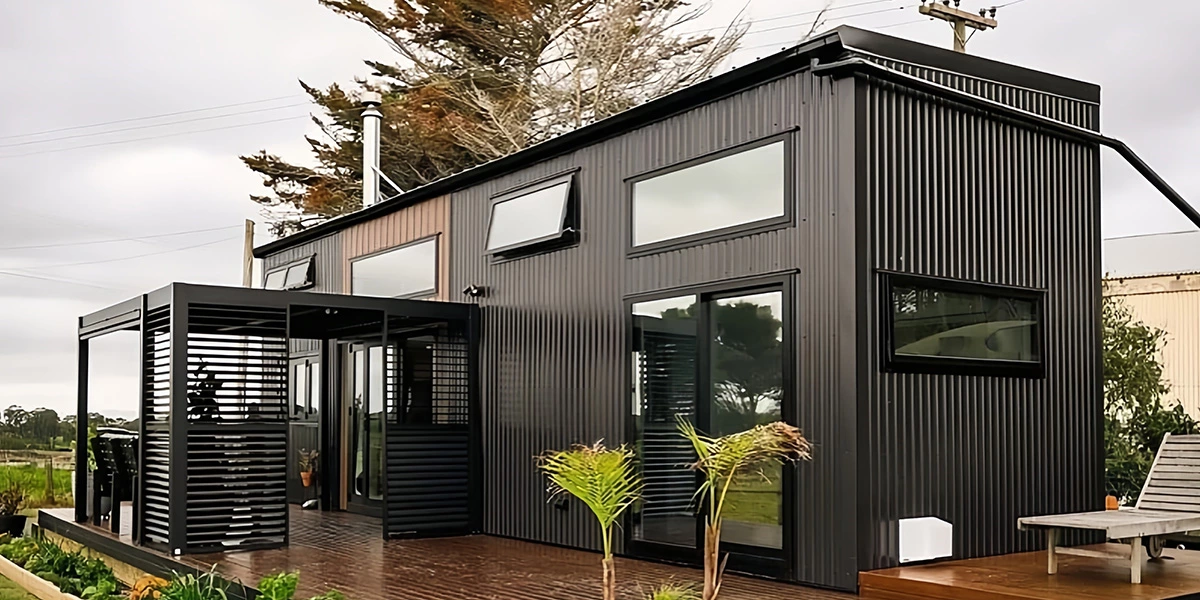
Expandable Container House vs Traditional Home: Which Is Right for Europe in 2026?
The European housing market is under pressure. Land costs in France, the Netherlands, and Germany have climbed steadily, planning permissions drag on for years, and sustainability regulations.
Enter the expandable container house: a factory-built, steel-framed dwelling that ships flat, assembles on-site in hours, and meets modern energy and structural codes. But is it truly a viable alternative to a traditionally built home for the European market? Or just a trend?
This guide breaks down the real numbers — cost, construction time, carbon footprint, resale value, and practical fit — so you can make an informed decision in 2026.

Cost Comparison: Container Home vs Traditional House in Europe
Build Cost
| Cost Category | Expandable Container House (UVO) | Traditional Build (EU Average) |
|---|---|---|
| Construction cost per m² | €900 – €1,400 | €1,800 – €3,500 |
| Foundation work | Minimal (point footings or ground screws) | Full concrete slab or strip foundation required |
| Labour on-site | 1 crew, 4–8 hours | Trades across 12–18 months |
| Architect / planning fees | Reduced (pre-engineered design) | Typically 8–15% of build cost |
| 52m² turnkey cost (estimate) | ~€55,000 – €85,000 | ~€140,000 – €200,000+ |
| Time to occupancy | Days to weeks (incl. delivery) | 12–18 months |
Note: Costs vary by country, site conditions, and specification. UVO units are quoted in factory-finished state; site connection costs (utilities hookup, groundwork) are additional and site-specific.
Ongoing Maintenance
Traditional masonry homes require regular maintenance — repointing, roof replacement, window refits — that compound over decades. UVO's hot-dip galvanised steel frame (2.3 mm wall thickness) is engineered to resist corrosion, moisture, and UV degradation with minimal upkeep. Exterior finishes are modular and replaceable without structural work.
5-year maintenance estimate:
- Traditional home: €8,000 – €15,000 (roof, damp, redecoration)
- UVO expandable house: €1,500 – €3,500 (seal checks, external finish touch-up)
Financing & Insurance
An increasing number of European lenders — particularly in Germany, the Netherlands, and the Nordics — now offer standard mortgage products for factory-built modular dwellings that meet EN 1090 / Eurocode 3 structural standards. UVO european expandable container house units carry CE certification under these frameworks, enabling conventional financing routes that were unavailable for early-generation container homes.
Sustainability Comparison: Which Is Greener?
Sustainability is no longer a marketing talking point in Europe
Embodied Carbon
| Factor | Expandable Container House | Traditional Build |
|---|---|---|
| Primary structure material | Recycled & recyclable steel (up to 95%+ recyclability) | Concrete + masonry (low recyclability) |
| Transport emissions | Single factory-to-site delivery | Multiple material deliveries over months |
| On-site waste | Near zero (factory-finished panels) | 40–60 kg/m² construction waste (EU avg.) |
| Demolition recyclability | 95%+ steel recovery at end of life | ~30–40% (mixed masonry/concrete rubble) |
| Insulation standard | Factory-installed 75-150mm+ EPS/PU/Rock wool | Varies; often retrofitted |
Operational Energy
UVO's expandable units are designed to accept triple-glazed window systems, MVHR (Mechanical Ventilation with Heat Recovery), and roof-integrated solar PV — all factory-prepped rather than retrofitted. With the right specification package, a UVO unit can achieve EPC A or equivalent under local assessment frameworks.
Speed of Construction: 4 Hours vs 12–18 Months
This is where the gap becomes impossible to ignore.
The Traditional Build Timeline
A typical 100m² new-build in Western Europe involves:
- Planning permission: 3–12 months (longer in France, UK, and Germany for full planning)
- Site preparation & foundations: 4–8 weeks
- Superstructure: 3–6 months (masonry) or 2–3 months (timber frame)
- First fix (electrical, plumbing): 4–6 weeks
- Second fix, plastering, finishing: 2–4 months
- Snagging, connection, sign-off: 4–8 weeks
Total: 12–18 months from groundbreak. Longer with planning delays.
During this time, the client pays financing costs, may be renting elsewhere, and has no usable structure.
The UVO Container Home Timeline
- Site preparation: Ground screws or point footings — 1–2 days
- Delivery: Factory-finished unit arrives by standard flatbed
- Deployment: Crane or forklift unfolds and levels the unit — as little as 4 hours
- Utility connection: Water, power, drainage — 1–3 days depending on infrastructure
- Ready to occupy: Often within 1–2 weeks of delivery
Total: Weeks, not months.
For commercial clients — resorts, glamping operators, temporary accommodation providers — the ability to generate revenue within days of a purchase decision is a transformative business advantage. For private clients, it means faster occupancy, reduced bridging finance costs, and zero construction disruption.

Resale Value and Relocatability: The Hidden Advantage
Traditional homes are permanently fixed to their plot. If planning regulations change, the neighbourhood deteriorates, or you simply want to move the asset — you can't. You sell the land and the structure together, at whatever the local market dictates.
UVO expandable homes offer something fundamentally different: the building can move with you.
Relocatability in Practice
- A UVO A-Frame or expandable unit can be folded, loaded onto a flatbed, and redeployed to a new site.
- This is particularly valuable for:
- Resort and hospitality operators expanding to new locations
- Agricultural landowners using temporary permitted development
- Businesses needing temporary offices or accommodation that follows project sites
- Landowners in uncertain planning contexts who want reversible development
Asset Protection in Changing Regulatory Environments
France's ZAN law, the UK's Levelling Up planning reforms, and similar policies across the EU are creating uncertainty around long-term land use. A relocatable structure is a hedge against planning risk. If a site's classification changes, the building can be moved — the capital doesn't evaporate.
Resale
While the container home secondary market is still maturing, factory-built units from established manufacturers retain value better than self-build or conversion projects. UVO units carry documented specifications, CE certification, and standard warranties — the kind of paperwork that supports resale, insurance, and financing.
Which Scenarios Favour a Container Home in Europe?
Container and expandable homes aren't right for everyone. Here's an honest guide to where they genuinely excel — and where traditional builds may still be preferable.
Container Homes Win When:
You need speed. A glamping resort adding 10 units for the 2026 summer season cannot wait 18 months for traditional construction. UVO delivers ready-to-occupy units.
Land is uncertain. Leased land, agricultural plots with permitted development, or sites under planning review are poor candidates for a permanent structure. A relocatable UVO unit gives you use of the land without locking capital into an immovable building.
Budget is constrained. At €55,000–€85,000 for a fully finished 52m² unit, the cost-per-habitable-square-metre is dramatically lower than comparable new-build, particularly in France, the Benelux, and the UK.
Sustainability is a priority. With 95%+ steel recyclability and near-zero construction waste, UVO expandable units score strongly against the embodied carbon requirements emerging across EU regulatory frameworks.
The site is difficult to access. Remote, island, or hillside sites that conventional plant and labour struggle to reach are well-suited to crane-deployable modular units with minimal groundworks.
You're building a portfolio. Hospitality and accommodation investors can deploy units progressively — start with two, add four more the following season — without committing to a single large traditional construction contract.
Traditional Builds May Still Be Preferable When:
- You require very large floor areas (200m²+) and a fully bespoke interior specification
- Local planning explicitly requires masonry or heritage-matched construction (conservation areas, listed settings)
- Mortgage product choice is limited by lender requirements for conventional construction
- You want a primary family residence with maximum permanence and community integration

The European Regulatory Picture in 2026
Europe expandable container home buyers need to navigate a patchwork of national and local rules. Key points for 2026:
- France: Requires compliance with RE 2020 for new habitable dwellings. UVO european expandable container house can be specified to meet these standards. ZAN policy makes relocatable structures increasingly attractive as an alternative to permanent land consumption.
- Germany: Structural certification under Eurocode 3 / EN 1090-1 is required for steel frame structures. UVO's CE-certified frame meets this standard.
- UK: Modular dwellings are increasingly recognised by lenders and planning authorities. The Future Homes Standard (effective 2025 onwards) favours high-performance factory-built units.
- Benelux & Nordics: Progressive planning environments; modular and tiny-house friendly policies in the Netherlands and Denmark are well-established.
Always verify local planning conditions before purchase. UVO's team can provide documentation and technical support for planning submissions.
Summary: Head-to-Head at a Glance
| Criterion | UVO Expandable Container Home | Traditional Build |
|---|---|---|
| Build cost per m² | €900 – €1,400 | €1,800 – €3,500 |
| Time to occupancy | Days to weeks | 12–18 months |
| On-site labour | Minimal (hours) | Extensive (months) |
| Carbon at end of life | 95%+ recyclable | ~30–40% recyclable |
| Construction waste | Near zero | 40–60 kg/m² |
| Relocatability | Yes — fold and redeploy | No — fixed in place |
| Planning flexibility | High (temporary / reversible) | Low |
| Maintenance cost (5-yr) | Low | Higher |
| Customisation ceiling | High (modular options) | Very high |
| Best for | Speed, sustainability, flexibility | Permanence, heritage settings |
Ready to Explore Your Options?
If you're developing a hospitality project, a private retreat, or a sustainable residential unit anywhere in Europe, UVO's engineering and sales team can help you build the right specification for your site, budget, and planning context.