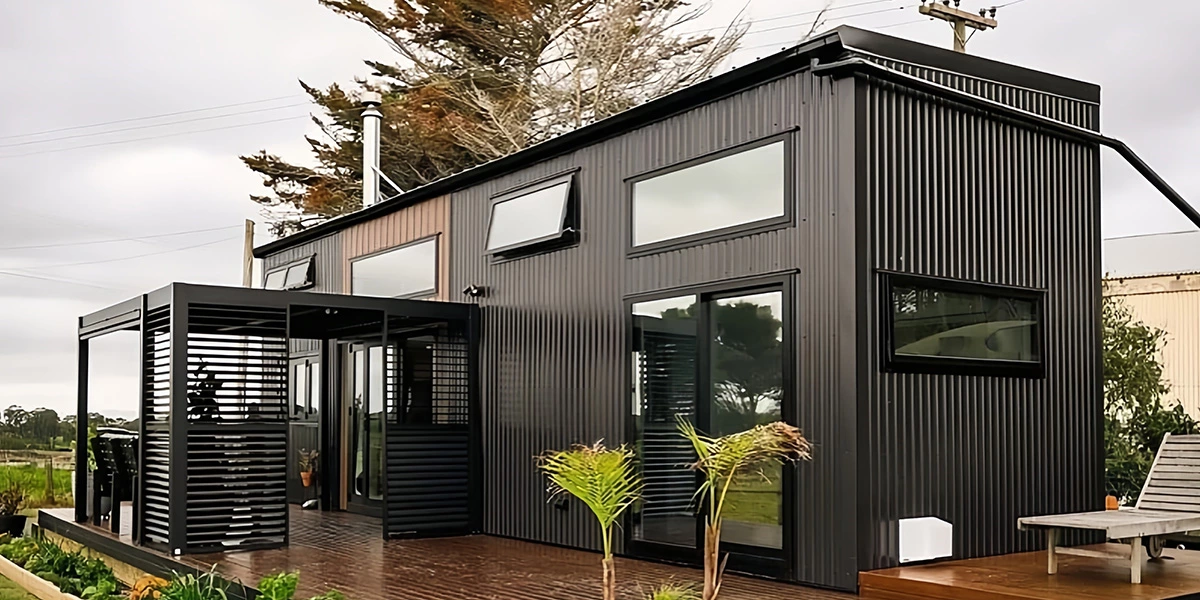
How to Choose an Expandable Container House Manufacturer: 2026 Complete Buyer's Guide
Choosing the wrong expandable container house manufacturer is one of the most expensive mistakes in the prefab housing market — and it happens more often than buyers expect. Behind the booming global demand for expandable container homes lies a market where trading companies outnumber genuine factories 10 to 1, where certifications are fabricated, and where buyers in Australia, the US, and Europe discover post-shipment that their units cannot pass council approval. This guide exists to prevent that outcome. It covers the 7 non-negotiable criteria for evaluating any expandable container house manufacturer, the red flags that expose trading company imposters, the 10 questions every serious buyer should ask, and how to verify manufacturer claims independently.
The State of the Expandable Container House Manufacturer Market in 2026
The global container homes market was valued at $68.24 billion in 2025 and is projected to reach $128.3 billion by 2034. This rapid growth has attracted thousands of new "manufacturers" — many of which are trading companies, photo aggregators, and intermediaries with no production facility at all.
The real breakdown of who you encounter when searching for an expandable container house manufacturer:
| Supplier Type | Est. % of Search Results | Key Risk |
|---|---|---|
| Genuine factories (direct) | ~15% | Minimum — if properly verified |
| Trading companies | ~45% | No quality control, no certification authority |
| Mixed (factory + trading) | ~25% | Inconsistent quality, unclear liability |
| Photo aggregators / brokers | ~15% | No inventory, delays, disappear post-payment |
The implication: when you search "expandable container house manufacturer" on Google or Alibaba, approximately 85% of results are not genuine factories. This is why independent verification of every supplier claim is non-negotiable.

Factory Verification — The Absolute First Step
No evaluation of an expandable container house manufacturer is valid without factory verification. This is also where trading companies are most easily exposed.
What to Verify
Physical facility scale: A genuine expandable container house manufacturer producing at commercial scale requires a minimum of 50,000㎡ of covered production floor to operate the steel cutting, panel fabrication, frame assembly, and pre-installation lines simultaneously. Factories with less than this cannot produce 100+ units per month.
Monthly production capacity: Ask for documented evidence — loading records, shipping manifests, or third-party inspection certificates — not a verbal claim. UVO's 300,000㎡ facility produces 400+ expandable container house units monthly, with documented loading records available on request.
Video verification: Request a live factory video call (not pre-recorded footage). Ask the camera operator to walk the production floor from raw material receipt through frame assembly, panel installation, pre-wiring, and pre-shipment inspection areas. A genuine expandable house manufacturer will accommodate this without hesitation.
Third-party factory audit: For orders over $50,000, commission a third-party inspection company (SGS, Bureau Veritas, or QIMA) to conduct an on-site factory audit before committing. Cost: approximately $500–$1,500. Value: eliminates the most catastrophic risks.
Certification Depth — The Non-Negotiable Compliance Test
Certifications are where the expandable container house manufacturer quality gap is most expensive and most visible. An uncertified unit that fails council approval in Australia or a building permit in the US results in total financial loss — not just a setback.
Australian Market Requirements
Any expandable container house manufacturer supplying Australia must provide:
| Certification | Standard | Cannot Be Substituted By |
|---|---|---|
| NCC Class 1a compliance statement | NCC 2022 | Chinese domestic certification |
| Structural engineering certificate | AS 1170/4100/4600 — Australian-registered engineer | Generic engineering docs |
| SAA electrical certification | AS/NZS 3000 | CE or other electrical certs |
| WaterMark plumbing certification | AS/NZS 3500 | NSF, DIN, or other plumbing certs |
| NATA asbestos-free test report | NATA-accredited laboratory | Any non-NATA lab report |
| Energy performance data (7-star NatHERS) | NCC 2022 | Energy Star or EPBD ratings |
Verification method: All SAA and WaterMark certifications can be verified in the Australian databases — SAA through Standards Australia, WaterMark through ABCB's online register. Ask the manufacturer for specific certification numbers and verify independently before committing.
US Market Requirements
| Certification | Standard | Applicability |
|---|---|---|
| IBC structural engineering certificate | International Building Code | Required for all US building permits |
| NEC-compliant electrical | NFPA 70 (National Electrical Code) | Required for US utility connection |
| UL-listed electrical components | Underwriters Laboratories | Required for legal US installation |
| ASCE 7 wind load compliance | American Society of Civil Engineers | Hurricane and wind zone requirements |
European Market Requirements
| Certification | Standard |
|---|---|
| CE marking | EU CPR 305/2011 (Construction Products Regulation) |
| EN 1090 structural steel | European steel structure standard |
| UKCA marking (UK post-Brexit) | UK equivalent of CE marking |
Structural Steel Grade — The Quality Gap Most Buyers Miss
The primary differentiator between a quality expandable container house manufacturer and a low-cost producer is the structural steel specification — and it is invisible in photographs.
Steel Grade Comparison: What It Means for Buyers
| Specification | G550 (Quality Standard) | Q235 (Budget Units) |
|---|---|---|
| Yield strength | 550 MPa | 235 MPa |
| Comparative strength | Baseline | 2.3× weaker |
| Australian NCC compliance | Meets AS/NZS 1397 | Fails Australian standard |
| Wind resistance | Level 11–12 (130–150 mph) | Level 8–10 (100–125 mph) |
| Galvanisation layer | ≥180g/㎡ (≥275g/㎡ coastal) | 80–120g/㎡ |
| Corrosion resistance | 25–30+ years | 8–12 years |
| Snow load capacity | Engineered to county-specific IBC | Generic — not county certified |

Localised Electrical Pre-Wiring
A critical and often overlooked aspect of choosing an expandable container house manufacturer is whether they can pre-install electrical systems to your specific market's standard — at the factory, before shipment.
| Market | Required Standard | What "Wrong" Looks Like |
|---|---|---|
| Australia | AS/NZS 3000 (240V/50Hz, Type I 3-pin) | Chinese 220V plugs, no RCD protection |
| USA | NEC/NFPA 70 (120V/240V, Type B 3-prong) | European or Chinese voltage/socket standards |
| UK | BS 7671 (230V/50Hz, Type G 3-pin) | Non-UK plug and MCB standards |
| EU | IEC 60364 (230V/50Hz, Type F sockets) | Non-EU MCB specifications |
A unit arriving with the wrong electrical standard requires complete rewiring — typically costing $3,000–$8,000 in licensed electrician time, plus a delay of 2–4 weeks. A quality expandable container house manufacturer builds the electrical system to your market's standard before the unit leaves the factory. Confirm this explicitly in the contract.
Supply Chain Stability and Delivery Track Record
A price that looks attractive at the quotation stage becomes catastrophic if the expandable container house manufacturer cannot deliver on time, at specification, or at all.
Supply Chain Verification Checklist
- Monthly production evidence: Ask for loading records or shipping manifests for the past 6 months — not a stated capacity claim
- Lead time in writing: Production lead time should be contractually committed (25–35 days is standard for quality manufacturers)
- Freight optimisation: Verify that the manufacturer's units are designed for efficient container loading — two 20ft units per 40HQ container is the standard; manufacturers who cannot achieve this are adding 50% to your per-unit freight cost
- Pre-shipment inspection: Confirm whether the manufacturer supports third-party pre-shipment inspection (SGS, BV, QIMA) — a quality expandable house manufacturer welcomes it
After-Sales Support and Warranty
A structural warranty of at least 10 years is the industry standard for a quality expandable container house manufacturer. Anything shorter suggests limited confidence in the build quality.
| Support Dimension | Minimum Acceptable | UVO Standard |
|---|---|---|
| Structural warranty | 10 years | 10+ years on frame and panels |
| Parts availability | 5 years post-delivery | Ongoing — standardised components |
| Technical documentation | Installation manual | Full manual + video + engineer support |
| Customisation depth | Colour and layout | Full OEM/ODM including electrical, solar, trailer chassis |
| Response time | 48 hours | 24 hours (WhatsApp and email) |
Why UVO Consistently Meets Every Criterion
UVO is a genuine factory-direct expandable container house manufacturer — not a trading company — with a 300,000㎡ production facility, 3,000+ employees, and 400+ units monthly production capacity.
| Verification Criterion | UVO Status |
|---|---|
| Live factory video | Available any business day |
| Monthly production evidence | Shipping manifests available on request |
| G550 steel mill certificates | Available per production batch |
| Australian certifications | NCC, SAA, WaterMark, NATA all held |
| US certifications | IBC structural certificate, NEC-compliant, UL-listed |
| European certifications | CE (CPR 305/2011), ISO 9001 |
| Market-specific electrical pre-wiring | AU 240V / US 110V / EU 230V at factory |
| Expansion cycle testing | 1,000+ cycle documented testing |
| Third-party inspection support | SGS, BV, QIMA all welcomed |
| Structural warranty | 10+ years |
| Reference projects | Available for AU, US, EU, UK, Middle East |
UVO is one of the few expandable container house manufacturers that simultaneously holds NATA, NCC/SAA/WaterMark (Australia), IBC/NEC/UL (USA), and CE/EN 1090 (Europe) — making it the only factory-direct source many buyers need regardless of which market they serve.
Frequently Asked Questions
What is the difference between an expandable container house manufacturer and a trading company?
A genuine expandable container house manufacturer owns and operates the production facility — controlling raw material sourcing, fabrication, quality inspection, and certification. A trading company acts as an intermediary, typically sourcing from multiple factories with no quality control authority. Trading companies cannot provide mill certificates, genuine factory audit access, or manufacturer-backed certification documents.
How do I verify that an expandable container house manufacturer is genuine?
Three independent verification methods: (1) Live video tour of the production facility — not pre-recorded footage; (2) Request mill certificates for steel used in your specific production batch and verify the steel mill directly; (3) Commission a third-party factory audit through SGS, Bureau Veritas, or QIMA before committing to any large order.
What certifications must an expandable container house manufacturer hold for Australia?
NCC Class 1a compliance statement, structural engineering certificate (AS/NZS 1170/4100/4600 by an Australian-registered engineer), SAA electrical certification (AS/NZS 3000), WaterMark plumbing certification (AS/NZS 3500), and NATA asbestos-free test report from a NATA-accredited laboratory. All five are required for council approval in any Australian state.
How much does a quality expandable container house from a certified manufacturer cost?
Ex-factory prices for a fully certified, residential-spec expandable container house from a quality manufacturer range from approximately $10,000–$18,000 (standard residential fit-out, 20ft) to $22,000–$38,000 (full fit-out, 40ft). Units below $6,000 are almost always uncertified shells — the certification gap makes them far more expensive in total when permit rejection and remediation costs are included.
Can a small factory produce quality certified expandable container houses?
Very rarely. The testing, certification, and documentation infrastructure required to serve regulated markets (Australia, US, EU) requires significant investment — typically only viable at production scales exceeding 100 units/month. Small factories producing 10–30 units/month typically cannot sustain the certification overhead and tend to serve unregulated markets only.
How long does it take a quality expandable container house manufacturer to produce and ship?
A quality expandable container house manufacturer should commit to 25–35 days production lead time. Ocean transit adds 20–42 days depending on destination (China to Australia: 20–30 days; China to US West Coast: 25–30 days; China to US East Coast: 35–42 days; China to Europe: 28–42 days). Total order-to-delivery: 7–11 weeks for most markets.
Ready to Evaluate UVO as Your Expandable Container House Manufacturer?
UVO welcomes all verification steps outlined in this guide — live factory tours, third-party audits, mill certificate requests, and reference project introductions. We are factory-direct, hold all certifications for Australia, USA, and Europe, and produce 400+ units monthly with a 25–35 day committed lead time.
Contact UVO for factory verification and a free project quotation →