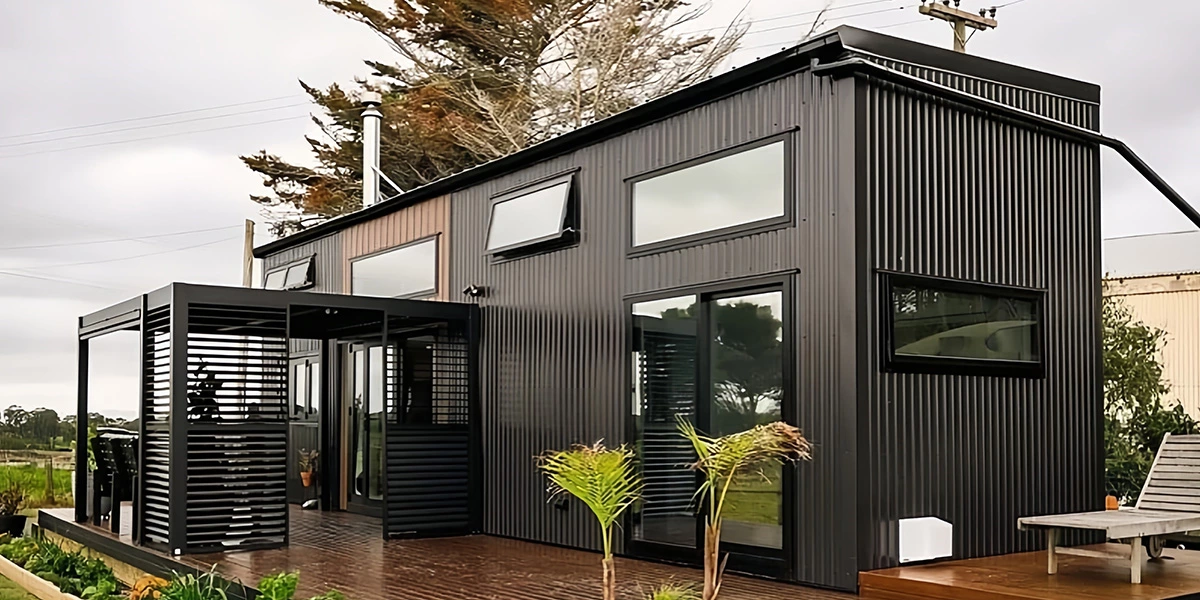
What Is a European Standard Expandable Container House? CE vs Non-CE Explained
If you have been searching for an expandable container house for delivery to Germany, France, Spain, Portugal, or Greece, you will have encountered two categories of product: units described as "CE certified" or "European standard," and units that carry no such designation. The price difference between the two can appear minor. The consequences of choosing the wrong one are not. This guide explains exactly what a European standard expandable container house means in legal and engineering terms, what CE certification actually requires, and why the distinction determines whether your unit can be legally installed, insured, and used across Europe.

What Is a European Standard Expandable Container House?
A European standard expandable container house is a factory-built modular dwelling that has been specifically engineered, tested, and certified to meet the full suite of European Union construction and product regulations — not simply a standard export product relabelled for the European market.
The term covers four distinct compliance dimensions:
1. Structural design to Eurocode 3 (EN 1993) The steel frame must be designed and independently certified under EN 1993 — the EU's definitive standard for structural steel. This includes load calculations specific to the installation location: wind speed zone, ground snow load, and seismic activity level. A standard Chinese export unit carries a GB 50017 structural certificate, which European building authorities do not recognise.
2. CE marking under EU CPR 305/2011 Under the EU Construction Products Regulation (CPR 305/2011), all structural building products placed on the European market must carry CE marking supported by a Declaration of Performance (DoP). This is not a self-issued sticker — it requires an independent EU notified body to audit the manufacturer's factory production control system. The DoP document specifies the exact performance levels the product achieves for each declared characteristic.
3. Energy performance compatible with EU directives France's RE 2020, Germany's GEG 2023, and the EU's Energy Performance of Buildings Directive (EPBD) all set minimum thermal performance requirements for new residential buildings. A European standard expandable container house uses Rock Wool insulation (λ ≤ 0.040 W/m·K), Low-E double glazing, and thermally broken frames to achieve the U-values required in each national market.
4. EU-standard electrical system The unit must be factory-wired to 230V/50Hz with Type F (Schuko) sockets and RCBO circuit protection compliant with EU Low Voltage Directive 2014/35/EU. A non-European-standard unit typically arrives with Chinese 220V wiring and non-EU socket formats, requiring complete rewiring before legal grid connection.
CE Certification: What It Actually Means (and What It Does Not)
CE marking is the most misunderstood element of the European standard expandable container house specification. Here is the precise legal definition:
What CE Marking Requires
Under EU CPR 305/2011, CE marking for a construction product requires:
- Factory Production Control (FPC) system: The manufacturer must have a documented quality management system for consistent production, audited by an EU notified body
- Declaration of Performance (DoP): A formal document, signed by the manufacturer, declaring the product's performance against each essential characteristic covered by the harmonised standard
- Notified Body assessment: For most structural products, an independent notified body (a third-party conformity assessment body recognised by an EU member state) must evaluate and verify the manufacturer's FPC system
- CE marking on the product: The CE mark must be accompanied by the DoP document number, the notified body identification number, and the year of first affixing
What CE Marking Does Not Mean
CE marking is not a quality award, a safety guarantee, or a government approval. It is a declaration by the manufacturer that the product meets the harmonised European standards for its category. The manufacturer bears legal responsibility for the accuracy of that declaration.
CE vs Non-CE: The Real Consequences for Buyers
This is where the theoretical difference becomes a practical and financial one.
Building Permit (Planning Permission)
When you submit a building permit application in Germany (Baugenehmigung), France (Permis de Construire), Spain (Licencia de obras), Portugal (Licenciamento), or Greece (Οικοδομική Άδεια), the local building authority will require evidence that the structure meets EU construction product standards.
A CE Declaration of Performance with EN 1993 structural engineering calculations satisfies this requirement directly. A non-CE unit requires expensive third-party re-certification — if it is achievable at all.
Building Insurance
European building insurers assess structural compliance as part of policy underwriting. A non-CE-certified structure may be:
- Classified as an uninsurable temporary structure
- Subject to significantly higher premiums
- Excluded from storm, flood, or structural failure coverage
A CE-certified European standard expandable container house is classified as a permanent compliant structure and insured accordingly.
Utility Connection
German and French utility providers require electrical installations to comply with local wiring standards before authorising grid connection. A non-EU-standard electrical system — Chinese voltage and socket format — will be rejected by the network operator's inspection. Rewiring a factory-installed Chinese electrical system costs €2,000–€5,000 and delays connection by 4–8 weeks.
Resale Value
A CE-certified, council-approved European standard expandable container house is a registered permanent structure on the property. An unapproved, non-CE structure is a liability — requiring mandatory disclosure and often forced removal when the property is sold. CE-certified units consistently command 15–25% higher resale values than non-certified equivalents.
The Technical Differences: CE vs Non-CE Expandable Container House
| Technical Dimension | CE-Certified (European Standard) | Non-CE (Standard Export) |
|---|---|---|
| Structural design standard | EN 1993 Eurocode 3 | GB 50017 (China only) |
| Steel frame grade | G550 (550 MPa yield strength) | Q235 (235 MPa yield strength) |
| Galvanisation | ≥180g/㎡ (AS/NZS 1397) | 80–120g/㎡ |
| Wall insulation | Rock Wool 75–100mm — Euroclass A1 | EPS 50–75mm — Euroclass D/E |
| Thermal conductivity | λ ≤ 0.040 W/m·K | λ ≤ 0.039 W/m·K (EPS) — lower R-value per mm |
| Fire classification | Euroclass A1 (non-combustible) | Euroclass D–E (combustible) |
| Window glazing | Double-glazed Low-E, thermal break frame | Standard double glaze, aluminium frame |
| Electrical standard | 230V/50Hz, Type F Schuko, RCBO | 220V, Chinese socket format, MCB only |
| Electrical directive | EU LVD 2014/35/EU compliant | Non-compliant |
| Flooring compliance | REACH regulation (EC 1907/2006) — no restricted substances | Not tested to EU standard |
| CE marking | DoP issued by EU notified body | None or component-level only |
| Planning permission support | Full documentation package included | Third-party re-certification required |
| Fire insurance | Standard residential rates | May be excluded or surcharged |
Why Rock Wool Matters: The Insulation Difference Explained
One of the most significant technical differences between a European standard expandable container house and a standard export unit is the insulation specification — and it has consequences beyond thermal comfort.
Standard export units use EPS (expanded polystyrene) foam panels. EPS is a cost-effective insulator, but it has two characteristics that create serious problems in the European regulatory environment:
Fire classification: EPS is classified Euroclass D or E — "combustible" under EN 13501-1. The EU's Construction Products Regulation requires wall lining and insulation materials in habitable structures to meet minimum fire hazard properties. In Germany, France, and most EU member states, Euroclass D/E insulation in a residential structure triggers additional fire protection requirements — sprinkler systems, fire-rated linings, or structural fire protection — adding €5,000–$15,000 to the project cost.
Rock Wool (mineral wool) is classified Euroclass A1 — non-combustible. It does not contribute to fire propagation, does not melt or drip, and does not release toxic gases in a fire. UVO's European standard units use Rock Wool as the standard insulation specification — not as an upgrade — precisely because Euroclass A1 is the correct specification for compliant European residential use.
How to Verify CE Certification: A Buyer's Checklist
Before committing to any European standard expandable container house purchase, use this verification checklist:
Step 1: Request the Declaration of Performance (DoP) The DoP is a formal document — not a certificate or a logo. It must contain:
- The product type designation
- The harmonised standard it is certified under (EN 14509 for sandwich panels; EN 1993 for steel frame)
- The notified body name and identification number
- The declared performance levels for each essential characteristic
- The manufacturer's name and address
- The year of first affixing CE marking
Step 2: Verify the Notified Body Take the notified body identification number from the DoP and search for it in the EU NANDO database (ec.europa.eu/growth/tools-databases/nando). If the notified body appears in NANDO and is listed as active for construction products, the CE marking is legitimate. If the body does not appear, or is not authorised for construction products, the CE marking is not valid.
Step 3: Request the EN 1993 Structural Engineering Calculations The structural engineering calculations should be site-specific — referencing the wind speed zone, snow load, and seismic zone for the installation location. Generic or location-agnostic calculations are a warning sign.
Step 4: Request the Electrical Compliance Documentation Confirm the unit is pre-wired to 230V/50Hz with Type F (Schuko) sockets and RCBO circuit protection. Ask for the EU Low Voltage Directive 2014/35/EU compliance statement.
Step 5: Request REACH Compliance Documentation All materials — flooring, wall panels, sealants — should carry EU REACH (EC 1907/2006) compliance statements confirming absence of restricted substances including phthalates, heavy metals, and formaldehyde above threshold levels.

UVO European Standard Expandable Container House: The Documentation Package
UVO's European standard expandable container house is supplied with a complete permit-ready documentation package that covers every item in the checklist above:
| Document | Standard | Purpose |
|---|---|---|
| CE Declaration of Performance | EU CPR 305/2011 | Pan-EU structural compliance — building permit submission |
| EN 1993 Structural Certificate | Eurocode 3 | Steel frame engineering — site-specific on request |
| Rock Wool Fire Classification | Euroclass A1 (EN 13501-1) | Non-combustible insulation — insurance and planning |
| EU LVD Electrical Compliance | 2014/35/EU | 230V Schuko system — grid connection approval |
| REACH Flooring Certificate | EC 1907/2006 | No restricted substances — residential occupancy |
| REACH Panel Certificate | EC 1907/2006 | Formaldehyde ≤ 0.05 mg/m³ |
| ISO 9001 Quality Certificate | ISO 9001:2015 | Factory production control system |
| RoHS Certificate | 2011/65/EU | Electronic components safety |
Frequently Asked Questions
Is CE marking mandatory for an expandable container house in Europe?
CE marking under EU CPR 305/2011 is mandatory for any structural construction product placed on the EU market. An expandable container house used as a habitable structure is a construction product under EU law. Without CE marking, the product cannot legally be used as permanent accommodation in any EU member state, and planning permission applications will be rejected.
Does CE certification expire?
The CE Declaration of Performance itself does not have an expiry date, but the notified body's approval of the manufacturer's Factory Production Control system is subject to periodic surveillance audits — typically annually. A certificate from a manufacturer whose FPC system is no longer under active notified body surveillance is not valid. Always confirm the notified body listing is current in the NANDO database.
Can I use a non-CE expandable container house as a temporary structure in Europe?
Some European jurisdictions permit temporary structures — typically defined as those on site for less than 12 months — with less stringent requirements than permanent buildings. However, "temporary" use for accommodation (sleeping, living) still triggers habitability requirements in most EU member states. If the unit is connected to utilities and used for sleeping, it will be treated as a habitable structure regardless of the owner's stated intent.
What is the difference between CE marking and ISO 9001?
CE marking (EU CPR 305/2011) certifies that the specific product meets EU harmonised performance standards. ISO 9001 certifies that the manufacturer has a quality management system capable of consistently producing compliant products. Both are present in UVO's documentation package: CE marking proves the product, ISO 9001 proves the process.