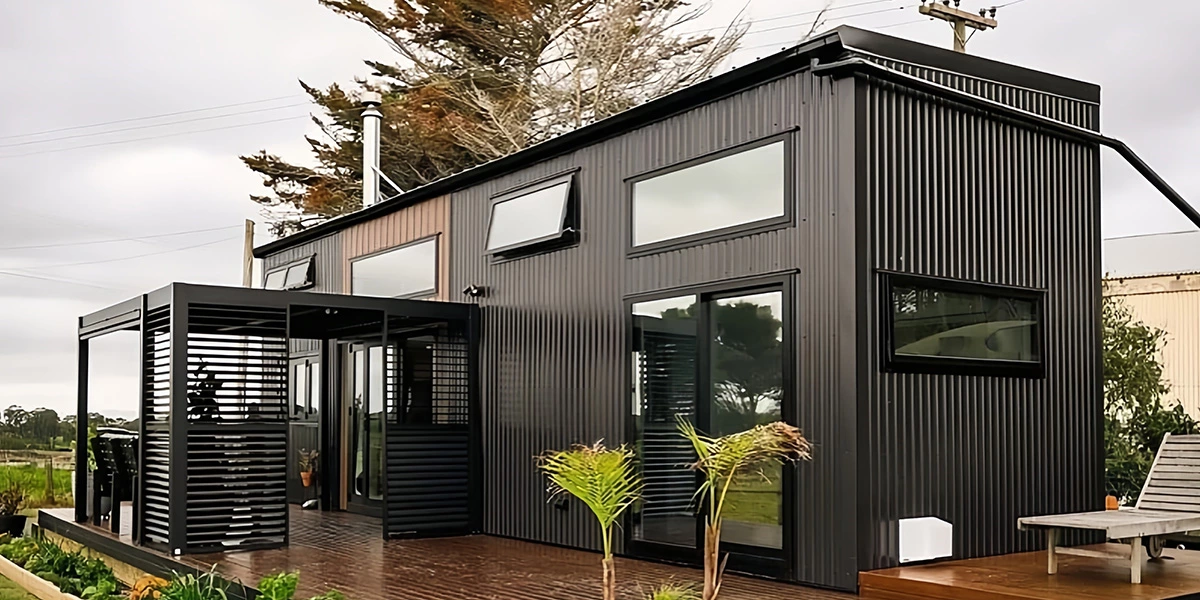
Top Prefabricated Container Home Manufacturers in China: 2026 Buyer's Verification Guide
China is home to thousands of companies claiming to manufacture prefabricated container homes — but industry data suggests that fewer than 15% are genuine factories with the engineering capability, certification infrastructure, and export experience required to serve regulated markets in the US, Australia, and Europe. This 2026 guide provides a systematic framework for evaluating any prefabricated container home manufacturer in China, covering factory verification criteria, certification requirements, red flags that expose trading companies, and the specific standards that distinguish Southern China's leading manufacturers from the competition.
The Reality of China's Prefabricated Container Home Industry
The global container homes market reached $68.24 billion in 2025 and is growing rapidly. This growth has attracted an enormous number of new entrants — many of whom are trading companies, photo aggregators, and brokers with no manufacturing capability whatsoever.
When you search for a prefabricated container home manufacturer in China on Alibaba, Made-in-China, or Google, you encounter roughly four types of results:
| Supplier Type | Est. Market Share | Core Risk |
|---|---|---|
| Genuine factories (direct) | ~15% | Minimal — if properly verified |
| Trading companies | ~45% | No quality control, no certification authority |
| Mixed (factory + trading arm) | ~25% | Inconsistent quality, unclear liability |
| Photo aggregators / brokers | ~15% | No inventory, ghost companies |
The practical implication: approximately 85% of suppliers you encounter are not genuine manufacturers. This is not a minor risk — buyers who discover post-shipment that their unit cannot pass local council approval face losses of $20,000–$80,000 with no recourse.

Why Southern China Dominates Container Home Manufacturing
China's prefabricated container home industry is geographically concentrated in two regions: Guangdong Province (Southern China) and Shandong Province (Eastern China). Each has distinct characteristics that matter for international buyers.
Southern China (Guangdong Province) Advantages
Export infrastructure maturity: Guangdong's Pearl River Delta hosts the world's largest concentration of export-oriented manufacturing. Ports including Guangzhou, Shenzhen, and Nansha handle over 60 million TEU annually — providing unmatched container shipping frequency and route options to all global destinations.
Certification ecosystem: Southern China's proximity to Hong Kong and decades of export manufacturing experience have produced a mature ecosystem of international certification bodies (SGS, Bureau Veritas, TÜV SÜD, Intertek) with permanent offices in Guangzhou and Shenzhen. This makes CE, SAA, WaterMark, and IBC certification audits faster and more accessible than in inland provinces.
Design and engineering talent: The Guangdong-Hong Kong-Macao Greater Bay Area has the highest concentration of architectural and structural engineering graduates in China. This translates into more sophisticated product design, better customisation capability, and more rigorous engineering documentation — all critical for regulated Western markets.
Labour quality: Guangdong's manufacturing workforce has 40+ years of experience producing precision export products. The tolerance for dimensional accuracy in Southern China's container home factories consistently exceeds what is achievable in lower-cost inland regions.
Eastern China (Shandong Province) Comparison
Shandong is the second-largest container home production region, with advantages in steel supply chain proximity (major steel mills are located in Hebei, adjacent to Shandong) and lower land and labour costs. The trade-off: certification infrastructure is less mature, export experience is more limited, and quality control systems are more variable.
For buyers prioritising price above all else, Shandong manufacturers can offer attractive unit prices. For buyers prioritising certification compliance, regulatory documentation, and international project experience — Guangdong is the more reliable source region.
Criteria for Evaluating Any Container Home Manufacturer in China
Factory Physical Verification
A genuine prefabricated container home manufacturer requires a minimum production floor of 50,000㎡ to run concurrent steel processing, panel fabrication, frame assembly, pre-wiring, and pre-installation operations at commercial scale.
How to verify:
- Request a live video call tour of the production facility — not pre-recorded footage
- Ask for the factory's business licence (营业执照) showing manufacturing scope — not just trade licence
- Commission a third-party factory audit (SGS, Bureau Veritas, or QIMA) for orders over $30,000
Red flag: Any supplier who resists a live factory video call or cannot provide a business licence with manufacturing scope is almost certainly a trading company.
Certification Depth — Market Specific
The certification a manufacturer holds determines where their products can be legally installed. The critical distinction: component-level CE marking is not the same as assembly-level CE certification.
| Market | Required Certification | What to Demand |
|---|---|---|
| Australia | NCC Class 1a · SAA (AS/NZS 3000) · WaterMark (AS/NZS 3500) · NATA asbestos-free | Physical certificates with certifying body name and number — verify against ABCB register |
| USA | IBC structural engineering certificate · NEC (NFPA 70) electrical compliance · UL-listed components | Stamped engineering certificate from US-registered PE, not generic document |
| Europe | CE marking (EU CPR 305/2011) · EN 1993 Eurocode 3 · Declaration of Performance (DoP) | DoP document with notified body number — verify against NANDO database |
Critical verification step: Every CE, SAA, and WaterMark certification has a publicly verifiable registration number. Ask the manufacturer for the exact certification number and verify it against the issuing body's online database before committing to any purchase.
Structural Steel Specification
The single most consequential quality variable — invisible in photographs — is the structural steel grade.
| Steel Grade | Yield Strength | Market Compliance | Common Use |
|---|---|---|---|
| G550 (AS/NZS 1397) | 550 MPa | Australia NCC · US IBC · EU EN 1993 | Premium manufacturers |
| Q345 | 345 MPa | Partial — requires engineering review | Mid-tier manufacturers |
| Q235 | 235 MPa | Fails Australian NCC, inadequate for most Western markets | Budget manufacturers |
How to verify: Request the mill certificate (test certificate) for the steel used in your specific production batch — not a generic brochure claim.
Market-Specific Electrical Pre-Wiring
A container home wired to Chinese or generic standards requires complete electrical replacement before it can be legally connected to grids in Australia, the US, or Europe — typically costing $3,000–$8,000 in licensed electrician time.
| Market | Required Standard | Socket Type | Voltage |
|---|---|---|---|
| Australia | AS/NZS 3000 · RCD protection | Type I (3-flat-pin) | 240V/50Hz |
| USA | NFPA 70 (NEC) · UL-listed | Type B (3-prong) | 120V/240V |
| Europe | EU LVD 2014/35/EU · RCBO | Type F (Schuko) | 230V/50Hz |
A quality container home manufacturer in China builds the electrical system to your market's standard before the unit leaves the factory. Confirm this explicitly in writing before signing any purchase agreement.
Pre-Shipment Inspection Track Record
Quality manufacturers welcome independent pre-shipment inspection because it confirms their own quality standards. Resistance to third-party inspection is one of the clearest signals of a trading company or low-quality manufacturer.
Recommended inspection agencies for China: SGS, Bureau Veritas, QIMA, Intertek, and TÜV SÜD all operate in Guangdong and can conduct factory and pre-shipment inspections. Cost: approximately $400–$800 per inspection — negligible relative to the risk of receiving a non-compliant unit.
After-Sales Warranty and Parts Availability
A structural warranty of 10 years minimum on the primary frame is the industry standard for quality manufacturers. Any warranty shorter than this indicates either limited confidence in build quality or a trading company that cannot honour manufacturer warranties.
Additional after-sales indicators:
- Replacement parts for hinges, seals, and hardware available with documented lead time
- Technical support accessible via direct communication (not only through resellers)
- OEM/ODM capability for customisation without wholesale price inflation

Why UVO Has Become a Benchmark Among Southern China Manufacturers
Among the established prefabricated container home manufacturers in Southern China, UVO (Guangzhou UVO Construction) consistently meets all seven criteria above. Here is the documented evidence:
| Verification Criterion | UVO Status |
|---|---|
| Factory verification | 300,000㎡ Guangzhou facility — live tours available any business day |
| Monthly production | 400+ units/month — shipping manifests available on request |
| Steel grade | G550 galvanised (AS/NZS 1397) — mill certificates per production batch |
| Australia certifications | NCC Class 1a · SAA · WaterMark · NATA — all active, verifiable |
| USA certifications | IBC structural certificate · NEC-compliant · UL-listed electrical |
| Europe certifications | CE (CPR 305/2011) · EN 1993 · ISO 9001 — DoP available |
| Market-specific electrical | AU 240V Type I · US 120V Type B · EU 230V Type F — factory pre-wired |
| Third-party inspection | SGS, BV, QIMA all welcomed — actively supported |
| Structural warranty | 10 years on primary frame |
| Founded | 2009 — 15+ years of international export experience |
| Export countries | 80+ countries across all major global markets |
UVO's Product Range: Four Certified Categories
As one of Southern China's most diversified prefabricated container home manufacturers, UVO's certified product range covers every major application segment:
1. Expandable Container Houses (20ft / 30ft / 40ft)
Factory-folded for shipping, deployed on-site to 2–3× transport width. Available in configurations from studio to 3-bedroom. The most popular format for ADU, granny flat, Airbnb investment, and permanent residence applications in Australia, the US, and Europe.
2. Folding Container Houses (Flat-Pack)
Maximum transport efficiency — 10–11 units per 40HQ container. Preferred for high-volume workforce accommodation, remote site housing, and cost-sensitive markets where freight is the dominant variable.
3. Apple Cabin (Capsule Pod House)
Aerospace-grade aluminium alloy shell with panoramic glazing. Designed for glamping resort, boutique accommodation, and premium short-term rental applications where visual distinctiveness drives booking premium.
4. A-Frame Triangle Tiny House (52㎡ and 29.4㎡ two-storey)
Prefabricated steel-frame A-frame cabin for scenic accommodation, backyard ADU, and resort cluster development. The highest nightly rate format in the UVO product range.

Common Mistakes Buyers Make When Sourcing in China
Mistake 1: Comparing only ex-factory prices
The cheapest ex-factory unit is almost always the most expensive total project when permit rejection, rewiring, and plumbing replacement costs are included. Compare total landed and compliance-ready costs.
Mistake 2: Accepting website certifications without verification
Many suppliers display CE, SAA, or IBC logos on their websites without holding current, verifiable certifications. Every certification has a registration number — verify it.
Mistake 3: Not specifying the electrical standard in the purchase agreement
If the contract does not explicitly specify the electrical standard (voltage, socket type, circuit protection format), you will receive Chinese standard wiring. This needs to be stated before production begins.
Mistake 4: Skipping the pre-shipment inspection
$600 spent on a pre-shipment inspection can save $20,000–$80,000 in project losses. No reputable manufacturer will refuse it.
Due Diligence Is the Only Protection
The prefabricated container home market from China offers genuine value — but only when you are purchasing from a verified manufacturer with the certifications, engineering capability, and export experience that your target market requires.
Frequently Asked Questions
How do I verify that a Chinese container home manufacturer is genuine?
Three independent verification steps: (1) Request a live video call of the production floor — not pre-recorded footage; (2) Request the Chinese business licence (营业执照) and verify the manufacturing scope and registered address; (3) Commission a third-party factory audit through SGS, Bureau Veritas, or QIMA before your first significant order.
Is Southern China or Eastern China better for container home sourcing?
Southern China (Guangdong) offers superior certification infrastructure, export experience, and engineering documentation capability — making it the better source region for buyers in regulated markets (Australia, US, EU). Eastern China (Shandong) can offer lower unit prices but with more variable quality control and less mature certification support.
What certifications does a container home manufacturer need for the Australian market?
NCC Class 1a compliance statement, SAA electrical certification (AS/NZS 3000), WaterMark plumbing certification (AS/NZS 3500), NATA-accredited asbestos-free test report, and structural engineering certificate from an Australian-registered engineer. All five are required for council approval in any Australian state.
How long does production and delivery take from a Southern China manufacturer?
Standard production: 25–35 days. Ocean freight to major destinations: 20–30 days (Australia), 25–35 days (US West Coast), 28–40 days (Europe). Total order-to-delivery: 7–11 weeks for most destinations.
Can I order a single unit from a Chinese prefabricated container home manufacturer?
Yes — quality manufacturers like UVO accept single-unit orders. Volume pricing applies from 5+ units, with significant discounts for resort-scale orders of 10+ units.