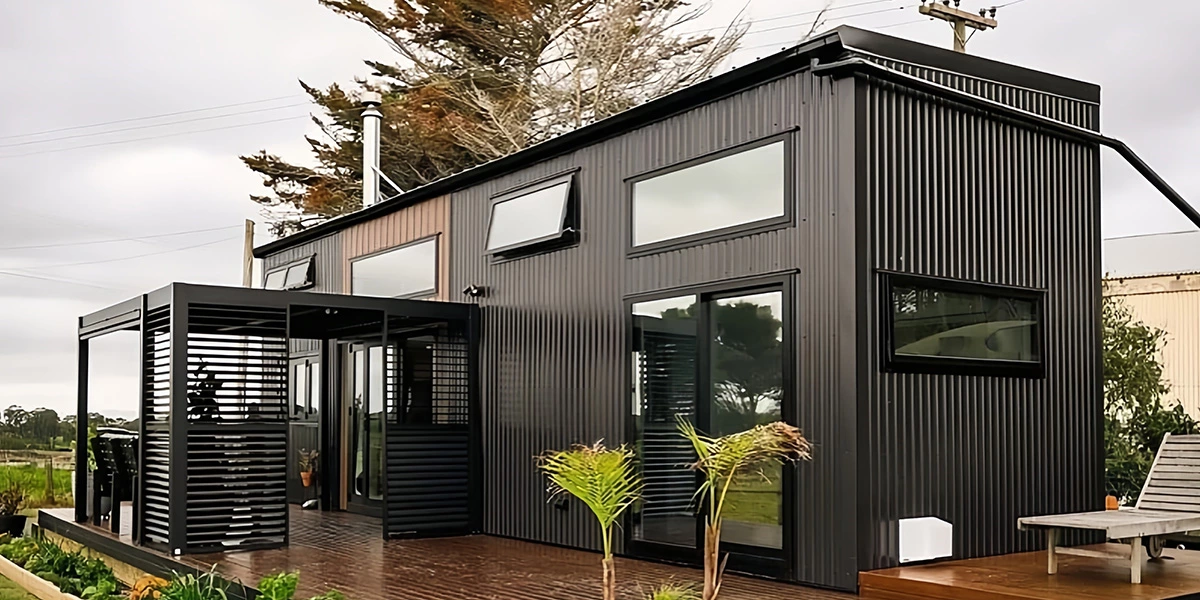
Expandable Container House in the USA: 2026 Cost, Permits & Buyer's Guide
So you've seen the videos. A truck pulls up, a compact steel box unfolds in a couple of hours, and suddenly there's a fully fitted house sitting on someone's land. Maybe you watched it on TikTok, maybe a neighbor mentioned it, maybe you've been priced out of traditional construction and you're looking for a real alternative. Whatever brought you here — this guide covers everything you actually need to know before buying an expandable container house in the USA: what they cost landed, which states are easiest to permit, what "IBC certified" really means, and how to tell a legitimate manufacturer.
What Is an Expandable Container House, Actually?
Let's be clear about what we're talking about, because the category gets muddled.
An expandable container house is a factory-built steel structure that ships folded to roughly standard container width — typically around 7.2 feet wide — and deploys on-site by unfolding the side wings outward, expanding the floor plan to two or three times its transport width. A 20ft unit goes from roughly 7 feet wide to about 21 feet wide. A 40ft unit expands to somewhere around 24 feet wide.
This is not a shipping container with windows cut into it. The structure is purpose-built as a residence or commercial space. It arrives with insulated wall panels, pre-framed windows and doors, pre-wired electrical conduit, and in most cases a partially or fully fitted interior. You put it on a foundation, connect utilities, and move in.
The appeal is straightforward: you get a weathertight, insulated structure in a few weeks for a fraction of traditional construction cost. The complications are real too — permitting, compliance, site prep, and the general complexity of importing a building from China all require careful planning.

The US Market in 2026: Why This Category Has Exploded
A few years ago, expandable container houses were a curiosity. You'd see them at trade shows or in YouTube videos from Southeast Asia. Today they're a serious option for a meaningful number of American buyers — and there are specific reasons why.
Construction costs haven't come back down. The surge in lumber, labor, and materials costs that started in 2021 hasn't fully reversed. Building a traditional 800 sqft ADU in California still runs $180,000–$350,000. In that context, a factory-built alternative that lands for $40,000–$70,000 all-in gets serious attention.
ADU law has gotten dramatically more permissive. California's AB 68, Oregon's statewide ADU mandate, Texas cities' removal of owner-occupancy requirements — the regulatory environment for secondary dwellings has opened up significantly across the country. This created a large market of homeowners who are legally allowed to add a dwelling on their property for the first time.
What Does an Expandable Container House Actually Cost in the USA?
This is the question everyone leads with, and the answer is genuinely complicated — because the price you see on any product listing is almost never the price you'll pay.
Here's the honest breakdown for 2026, based on UVO's expandable container house for sale in USA actual US delivery data:
20ft Expandable Container House
| Cost Component | Low | High |
|---|---|---|
| Ex-factory unit (American standard spec) | $6,999 | $15,000 |
| Ocean freight (China → US West Coast port) | $3,500 | $5,500 |
| US customs and import duties | $350 | $800 |
| Inland trucking (port → your site) | $800 | $3,500 |
| Foundation | $1,500 | $5,000 |
| Building permit and engineering review | $1,500 | $8,000 |
| Utility hookups (electrical + plumbing) | $2,000 | $8,000 |
| Total all-in | $16,649 | $45,800 |

40ft Expandable Container House
| Cost Component | Low | High |
|---|---|---|
| Ex-factory unit | $13,000 | $28,000 |
| Ocean freight | $5,000 | $8,000 |
| US customs | $700 | $1,500 |
| Inland trucking | $1,200 | $4,500 |
| Foundation | $3,000 | $8,000 |
| Building permit and engineering | $2,000 | $10,000 |
| Utility hookups | $3,000 | $12,000 |
| Total all-in | $27,900 | $72,000 |

A few things to notice in these numbers:
The inland trucking range is wide because it depends entirely on where you are. If you're 30 miles from the Port of Los Angeles, you're at the low end. If you're in rural Montana, you're at the high end. Get a trucking quote for your specific address before finalizing your budget.
Permit costs vary more than almost anything else. In some Texas counties, you'll pay a few hundred dollars and get approval in weeks. In some California jurisdictions, you're looking at thousands of dollars and months of process. Know your local authority before you commit.
Foundation is often the cost people underestimate most. A simple gravel pad works in some jurisdictions. Others require engineered concrete piers or a full slab. Your local building department will tell you what they require. Don't assume.
Explore our turnkey configurations and FOB pricing on the [American Standard Expandable Container House] product page.
The Permit Question: What States Are Actually Workable?
Expandable container houses can be permitted as permanent dwellings in every US state. The process, timeline, and cost vary enormously.
California
California has arguably the most permissive ADU law in the country right now. Under SB 1211 and related legislation, ADUs up to 1,200 sqft are entitled to ministerial (non-discretionary) approval within 60 days on most residential lots. The local authority cannot deny a compliant application based on aesthetics or neighborhood character.
For a 20ft expandable unit (approximately 398 sqft), you're well within size limits. For a 40ft (approximately 807 sqft), you're also within limits. What California does require: a HERS energy compliance report, and your unit needs to demonstrate it meets California's current energy code.
Coastal California (meaning most of Southern California and the Bay Area) has higher construction costs for the permit process itself, but the ADU law means you can't be arbitrarily denied.
Texas
Texas is the most permissive major state for expandable container houses as residential structures. Unincorporated areas — which cover a large portion of the state — often have minimal or no residential building codes at all. You can place a structure, connect utilities, and live in it without the formal permit process that other states require.
Within cities: Houston has no traditional zoning code, making it one of the most flexible urban environments in the country. Austin allows ADUs by right on most residential lots since 2023, with no owner-occupancy requirement. Dallas and San Antonio have straightforward ADU processes.
If you own rural land in Texas and want a simple, low-bureaucracy path to a habitable structure — this is probably your easiest market.
Florida
Florida is workable but has one non-negotiable requirement that affects expandable container houses specifically: wind load compliance. Much of Florida — particularly anything within 100 miles of the coast — is in a High-Velocity Hurricane Zone (HVHZ) requiring structures to meet wind speeds of 140–170 mph.
UVO's American standard expandable units are rated for Wind Load Level 11–12 (130–150 mph) as standard, and can be specified with enhanced structural packages for HVHZ requirements. The key is that your structural engineering certificate must specifically address the wind speed zone for your installation county. Don't try to use a generic document — Florida's building departments will catch it.
Oregon and Washington
Both states have strong ADU-by-right laws. Oregon mandated ADU allowances on all single-family lots statewide in 2022. Washington's major cities — Seattle, Spokane, Tacoma — all have active ADU programs.
The Pacific Northwest is also a strong market for expandable container houses used as vacation rentals, given the demand for short-term accommodation near outdoor recreation areas. Cascade foothills, Olympic Peninsula, and the coast all have strong Airbnb markets.
Colorado
Colorado is great for demand (strong short-term rental markets, outdoor recreation, relatively high incomes) and more complicated for permitting — specifically in mountain counties. If your site is above 7,000 feet elevation, you're likely dealing with significant snow load requirements. Mountain counties like Park County, Summit County, and Clear Creek County have specific snow load engineering requirements that a generic structural certificate won't satisfy.
What "IBC Certified" Actually Means — and How to Verify It
Every expandable container house listing in the USA claims some version of compliance. Here's how to sort legitimate documentation from marketing copy.
IBC (International Building Code) is the model building code that most US states have adopted, in whole or with amendments. When a manufacturer says their unit is "IBC certified," what this should mean is that a licensed professional engineer (PE) has reviewed the structural design and certified in writing that it meets the relevant IBC structural chapters — specifically Chapter 16 (structural loads), which covers dead loads, live loads, wind loads, and seismic loads.
The certificate should:
- Name the specific installation location or wind/seismic zone it covers
- Be signed and stamped by a PE licensed in the relevant state
- Reference the specific IBC edition it certifies against (current: IBC 2021)
A generic "IBC compliant" sticker on a brochure means nothing. A stamped PE letter for your specific project means everything.
NEC (National Electrical Code / NFPA 70) compliance means the factory-installed electrical system uses the correct voltage (120V/240V), the correct outlet format (US 3-prong Type B), and complies with the NEC's requirements for circuit protection (AFCI breakers in bedrooms, GFCI in wet areas). UVO's American standard units use UL-listed electrical components throughout and are configured to connect directly to a US electrical service without rewiring.
ICC-ES ESR Report — An ICC-ES Evaluation Service Report (ESR-5518). This is a third-party technical review conducted by ICC's evaluation subsidiary that confirms the product meets the referenced standards. Building departments in many states will accept an ESR report as sufficient technical documentation in place of individual structural review. It's one of the more meaningful certifications in this space.

ICC-ES ESR-5518: The Structural Certification That Matters to US Building Departments
When you submit a building permit application in the United States — whether that's in Los Angeles, Houston, Miami, or anywhere else — the local building official will want documented evidence that the structural framing system in your expandable container house meets US code requirements. This is where ICC-ES ESR-5518 becomes relevant.
What ESR-5518 actually is:
ICC-ES (ICC Evaluation Service) is a subsidiary of the International Code Council — the organization that publishes the IBC and IRC codes that most US jurisdictions have adopted. An Evaluation Service Report (ESR) is a formal third-party technical review confirming that a specific product is compliant with, or is a suitable alternative to, what those codes require.
ESR-5518 covers the cold-formed steel framing members used in expandable container house structures — the steel studs, tracks, and framing components that form the structural skeleton of the unit. The report confirms these members comply with:
- 2024, 2021, and 2018 International Building Code (IBC)
- 2024, 2021, and 2018 International Residential Code (IRC)
The steel framing is manufactured from S350GD+Z grade steel with Z275 (G90) galvanized coating, with a minimum yield strength of 350 MPa (50.7 ksi) — the specification verified in the report.
What to Look for When Comparing Suppliers
The expandable container house market in the USA ranges from serious manufacturers with real factories and documented processes to photo aggregators who source whatever unit they can find when you place an order. Here's how to tell the difference.
Ask for a live factory video call. Not a pre-recorded tour — a live call where you can ask the camera operator to walk specific parts of the facility. A real manufacturer with 200+ employees and a production floor will accommodate this. A trading company that sources from third-party factories will stall or send you pre-recorded footage.
Ask for the steel mill certificate. The certificate that comes with the steel used in your specific production batch — not a general product spec sheet. It should show the steel grade (G550 or equivalent), the yield strength in MPa, and the galvanization weight in g/m². UVO uses G550 grade steel with 180g/m² galvanization as standard. Budget suppliers typically use Q235 steel (235 MPa versus 550 MPa — less than half the strength) with minimal galvanization.
Ask for verifiable certification numbers. UL listing numbers can be checked at ul.com/listings. ICC-ES report numbers can be checked at icc-es.org. If a supplier claims certifications but can't provide numbers you can independently verify, treat the claim as unverified.
Check the delivery timeline against your own schedule. Production takes 25–35 days at a functioning factory. Ocean freight to a US West Coast port takes 25–30 days; East Coast takes 35–42 days. Anyone promising US delivery in less than 7 weeks from order is either already holding inventory or overpromising.
UVO's American Standard Unit: What's Actually Included
Since this guide is published by UVO, it's fair to be specific about what we actually ship rather than speaking in generalities.
UVO's USA expandable container house for sale is built with:
- G550 galvanized steel frame — 2.3mm wall thickness, 550 MPa yield strength. This is the same grade used in Australian and European standards, not a downgrade for the US market.
- 75mm EPS insulated sandwich panels as standard, with 100mm Rock Wool available for cold-climate states (Colorado, Minnesota, the Northeast). The Rock Wool option meets higher energy code requirements in Climate Zones 5–7.
- UL-listed electrical components throughout — 120V/240V split-phase wiring, US Type B outlets, AFCI breakers in sleeping areas, GFCI in bathrooms and kitchen.
- NSF/ANSI-certified plumbing fixtures where applicable to US health code requirements.
- ICC-ES ESR-5518 report included with every unit — this is the document that US building departments use to evaluate the structural system.
- PE-stamped structural engineering letter available for any US state, specifying wind and seismic loads for the installation county.
What's not included in the base price: flooring finish, kitchen cabinetry, bathroom fixtures, and appliances — these are quoted separately because buyer preferences vary widely. The structure, insulation, windows, pre-wired electrical conduit, and plumbing rough-in are standard.
We've delivered to California, Texas, Minnesota, Florida, and Georgia. The projects we've seen succeed have one thing in common: the buyer did their permit homework before ordering, not after. The ones that ran into trouble almost always involved someone who assumed the permit would be easy to get.
Financing Options for US Buyers
Cash is not the only option for buying an expandable container house for sale in the USA. Depending on your situation:
HELOC (Home Equity Line of Credit) — If you own a home with equity, this is typically the lowest-cost financing option available. Current rates in the 7–9% range. No restriction on what you use the funds for. Ideal for ADU installations where the expandable house will increase your property's appraised value.
Personal loan — Platforms like LightStream, SoFi, and Upgrade offer unsecured personal loans up to $100,000 without home equity. Rates currently 8–15% depending on credit profile. Funded in days.
CalHFA ADU Grant (California only) — California homeowners may qualify for up to $40,000 in forgivable pre-development loan assistance through the CalHFA ADU Grant Program. Not a loan you repay — if you meet the income and property requirements, it's a grant. UVO's American standard units qualify when installed on a permitted permanent foundation.
The State-by-State ADU Quick Reference
| State | ADU by Right? | Key Restriction | UVO Unit Eligible? |
|---|---|---|---|
| California | Ministerial approval | 60-day decision; max 1,200 sqft | Both 20ft and 40ft |
| Texas (rural) | Minimal requirements | Unincorporated areas often permit-free | Both sizes |
| Texas (Houston) | No zoning code | Standard building permit only | Both sizes |
| Florida | County-by-county | HVHZ wind cert required near coast | With county-specific cert |
| Oregon | Statewide mandate | By-right on all single-family lots | Both sizes |
| Washington | Strong ADU laws | 1,000 sqft max in many cities | Both sizes |
| Colorado (Denver) | Active ADU program | Standard permit process | Both sizes |
| Colorado (mountain) | Varies by county | Snow load cert required above 7,000ft | With site-specific cert |
| Arizona | Permissive | Phoenix/Scottsdale/Tucson all active | Both sizes |
| Tennessee | Permissive | Rural counties minimal restriction | Both sizes |
| Georgia | Permissive | Atlanta metro and rural both active | Both sizes |
Frequently Asked Questions
Can I put an expandable container house in my backyard in the US? In most US jurisdictions — yes, with a building permit. The specific process depends on your state, county, and whether your property is in an HOA. California, Oregon, Texas, and Arizona have particularly streamlined ADU processes. Always check your zoning and HOA documents before ordering.
How long does the whole process take from order to move-in? Plan for 3–5 months. Production runs 25–35 days, ocean freight adds 30–42 days depending on your port, and permit processing adds 4–12 weeks depending on your jurisdiction. If your site prep (foundation, utility trenching) runs in parallel with production and shipping, the timeline compresses significantly.
Is it true that Chinese container houses can't be permitted in the US? This gets repeated online and it's not accurate. The question isn't where the structure was made — it's whether the structure meets the relevant US codes (IBC for structure, NEC for electrical) and can be documented with verifiable certifications. Units that come with PE-stamped engineering letters, ICC-ES reports, and UL-listed electrical components can be and are permitted across the US every month. Units that arrive with no documentation or unverifiable claims are a different story.
What's the minimum credit score for financing an expandable container house? For HELOC financing, lenders typically want 680+ and at least 20% equity. For personal loans through platforms like LightStream, 660+ is a common threshold for competitive rates. Some BNPL construction-financing platforms work with scores as low as 580.
Ready to Get Specific?
This guide covers the general landscape. Your actual project — your county, your lot, your HOA situation, your foundation type, your intended use — is going to have specifics that a guide can't anticipate.
If you've read this far and you're seriously considering an expandable container house for sale in the USA, the most useful next step is a direct conversation about your project parameters. We can tell you whether your county's permit history suggests a smooth or complicated path, what engineering documents you'll need, and what an honest all-in cost estimate looks like for your specific location. Contact UVO to customize your own home →